Professional Digitizing Service for Embroidery: A 2026 Quality Checklist and Buyer’s Reference
Your embroidery machine’s most expensive hour isn’t when it’s running at 800 stitches per minute; it’s when it’s sitting idle because of a bird’s nest or a snapped thread. You likely understand the frustration of a file that looks perfect on screen but causes constant downtime on the production floor. Unpredictable turnaround times and complex, stitch-count-based pricing models only add more friction to your creative process. It’s time to stop treating digitizing as a simple administrative task and start seeing it as a core production strategy.
This guide provides a comprehensive embroidery digitizing quality checklist to help you identify partners who deliver production-ready DST files designed for maximum efficiency. You’ll master the technical criteria required to reduce machine runtime per garment and ensure your overhead stays predictable with flat-rate models. We’ll examine the essential shift toward manual precision over AI shortcuts and the specific benchmarks that separate a simple file converter from a true production partner. By the end of this reference, you’ll have the tools to ensure your designs run smoothly on the first stitch-out.
Key Takeaways
- Professional digitizing acts as a technical bridge, using manual pathing to minimize jumps and ensure efficient machine commands.
- Follow this embroidery digitizing quality checklist to secure predictable flat-rate pricing and reliable turnaround times for every project.
- Master fabric-specific optimization techniques that account for material push and pull to prevent registration errors on complex garments.
- Leverage global service hubs and rush processing to accept larger contracts while maintaining a 24/7 production cycle.
What to Expect from a Professional Digitizing Service for Embroidery
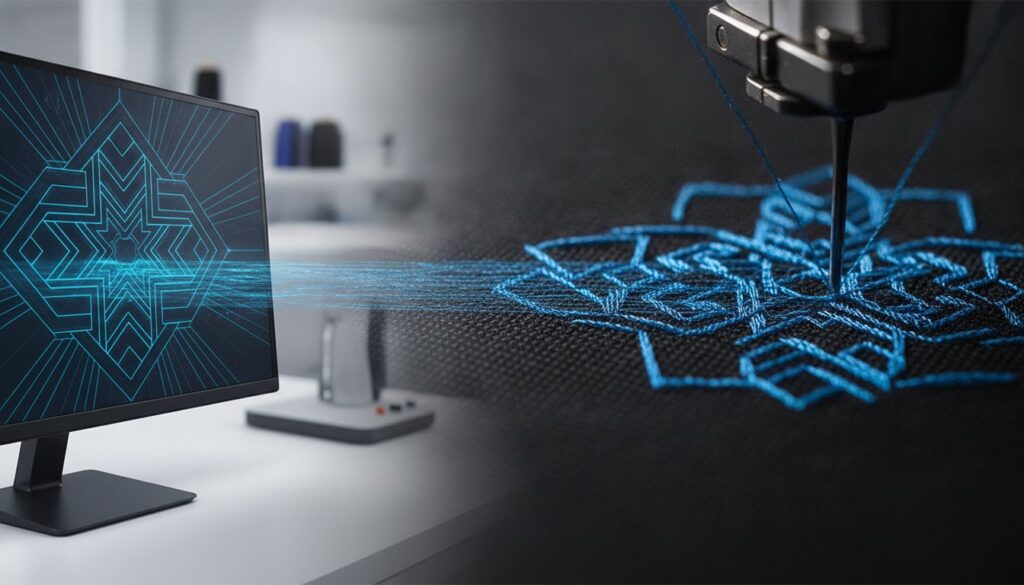
A professional digitizing service functions as the essential technical bridge between creative artwork and the mechanical reality of your embroidery machine. It isn’t a simple file conversion. It’s a complex engineering process that translates pixels into precise needle movements. When you evaluate a provider using an embroidery digitizing quality checklist, the first thing you should look for is a “First Time Right” philosophy. This mindset ensures that the design runs perfectly on the first stitch-out, eliminating the need for expensive production samples and wasted garments. Professional partners perform a detailed analysis of artwork complexity before a single stitch is placed to ensure the design is truly production-ready.
Manual Pathing vs. Automated Software
Automated digitizing tools often promise speed, but they lack the logic required for high-speed commercial production. These tools frequently create inefficient paths with excessive jumps and bird-nesting patterns that can lead to broken needles or ruined fabric. A professional human digitizer manually determines the optimal sequence of every design element. They plan logical start and stop points that minimize movement across the frame. This manual precision significantly reduces thread trims and increases your machine’s overall speed; you’ll complete more garments per hour without constant operator intervention.
Technical Analysis of Artwork for Embroidery
True expertise begins with a detailed analysis of your artwork before the first stitch is even digitalized. Professional digitizers evaluate line weights and small text to ensure legibility and structural integrity. If a line is too thin for a needle to physically replicate, a pro will suggest adjustments. They also identify specific areas that require specialized underlay, which provides the necessary stability for different fabric types. This prevents the design from sinking into the fabric or puckering during the run.
Translating complex color gradients is another area where human skill outperforms software. Achieving a smooth transition requires expert embroidery digitizing to blend thread colors effectively without creating excessive density. By analyzing these variables upfront, a professional service removes the friction from your production cycle. You get a file that isn’t just a design; it’s a production-ready instruction set. This level of technical scrutiny is a non-negotiable item on any professional embroidery digitizing quality checklist for 2026.
The Essential Embroidery Digitizing Quality Checklist for 2026
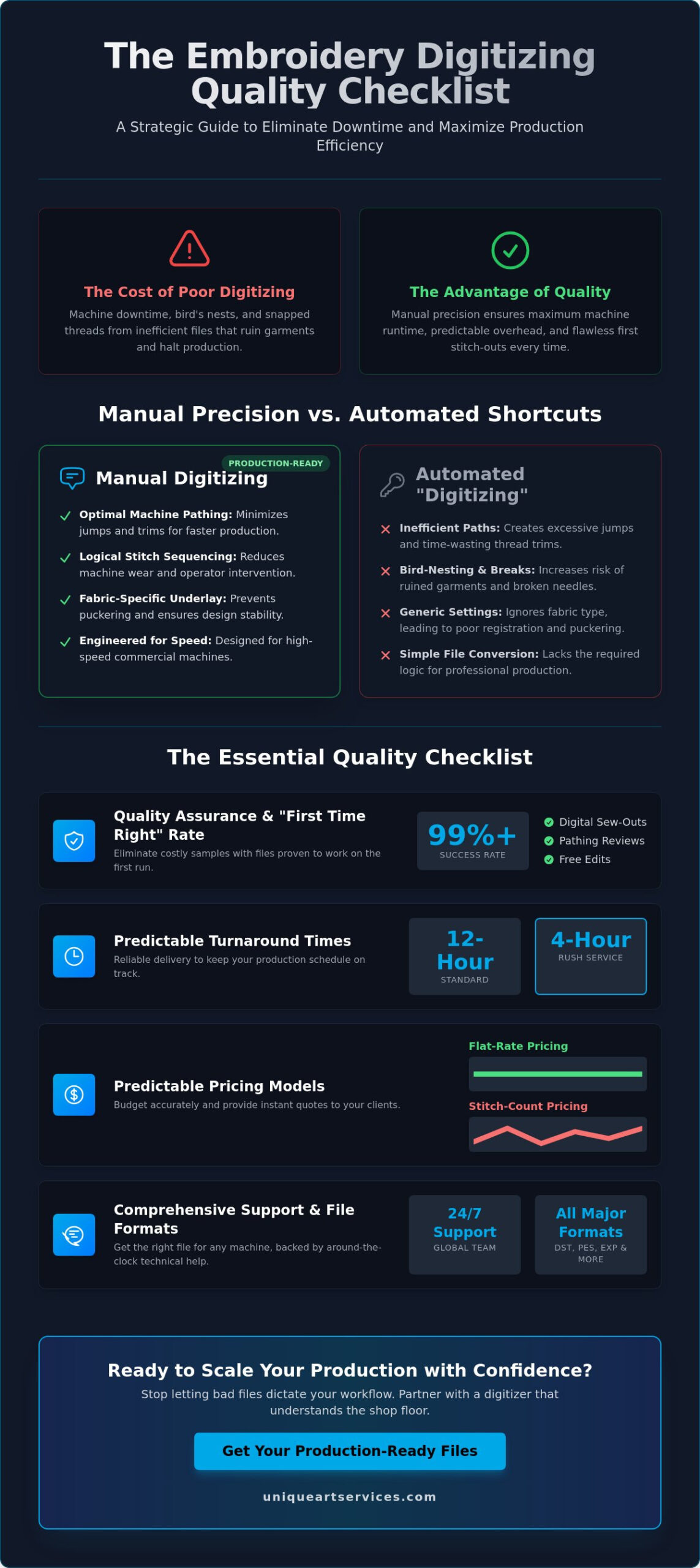
Selecting a partner requires more than a quick look at a portfolio. You need a rigorous embroidery digitizing quality checklist to ensure your shop remains profitable and your machines stay running. In 2026, the standard for professional service has shifted toward total transparency and technical reliability. This means your partner must offer consistent turnaround times, ranging from a standard 12-hour window to a 4-hour rush for emergency orders. Without this predictability, your production schedule is at risk.
A high-tier service also provides comprehensive file format support. Whether you operate Tajima, Brother, or Melco machines, you should receive files in DST, PES, or EXP formats without compatibility issues. This technical flexibility must be backed by 24/7 customer support. When a technical glitch happens at 2:00 AM during a night shift, you need a global team ready to troubleshoot across time zones. Reliability isn’t just about the file; it’s about the support system behind it.
Quality Assurance and First-Time-Right Benchmarks
The industry benchmark for commercial success is now a 99% or higher first-time-right rate. This isn’t achieved by luck. It’s the result of strict quality assurance protocols. Every file should undergo a pathing review and a digital sew-out simulation before delivery. These simulations identify potential thread breaks or density issues on the screen, preventing them from ever reaching your production floor. If minor adjustments are needed, your partner should offer free edits to maintain a friction-free workflow. If you want to see how these standards apply to your specific needs, you can explore professional digitizing options designed for high-volume shops.
Pricing Models: Flat-Rate vs. Stitch-Count
Predictability is the backbone of a successful embroidery business. Flat-rate pricing models have become the preferred choice for 2026 because they allow for precise budgeting and instant client quoting. Unlike stitch-count pricing, which often fluctuates between $2.00 and $4.00 per 1,000 stitches, flat rates eliminate the guesswork. Stitch-count models can also create a conflict of interest. They may incentivize “over-digitizing” to inflate the final cost of the job.
By prioritizing flat-rate fees, you ensure that the design is optimized for thread economy rather than price padding. You should also evaluate the ROI of rush order surcharges. Paying a premium for a 4-hour turnaround is often more cost-effective than letting a multi-head machine sit idle for an entire shift. Using this embroidery digitizing quality checklist helps you secure a partner that values your bottom line as much as your design quality.
Optimizing for Production: Stitches, Density, and Fabric Types
Technical optimization is the point where digitizing transforms from a creative service into a financial strategy. While earlier points on your embroidery digitizing quality checklist focused on service reliability, production optimization focuses on “profit per machine hour.” Every unnecessary stitch in a design represents wasted thread and lost time. A professional digitizer understands how to reduce overall stitch counts without sacrificing coverage. This efficiency ensures your multi-head machines run faster and your material overhead remains low.
Density management is equally critical for garment quality. Poorly digitized files often result in “bulletproof” designs that feel stiff and heavy on the wearer’s chest. High-quality digitizing utilizes strategic underlay stitches to secure the design to the stabilizer first. This creates a solid foundation, allowing for a lighter top stitch density that still provides crisp edges and full coverage. By mastering this balance, you deliver a retail-quality feel that keeps your clients coming back.
Managing Push-Pull Compensation
Expert digitizers account for the physical physics of fabric. Knit fabrics tend to stretch and pull, while woven materials may shift during the embroidery process. If a file isn’t digitized with push-pull compensation, the registration will fail, leaving unsightly gaps between colors. This is especially vital for performance polyester and stretchy athletic blends. A professional partner makes technical adjustments to the design’s geometry to ensure that once the needle hits the fabric, every element lands exactly where it should across thousands of production units.
Fabric-Specific Standards: Hats vs. Polos
A “one-size-fits-all” file is a recipe for production failure. Structured six-panel caps require a specific center-out pathing strategy to prevent the fabric from bunching or shifting against the needle plate. Conversely, pique knits used in polo shirts require higher density in specific areas to prevent stitches from sinking into the fabric’s mesh-like texture.
Your shop’s efficiency depends on selecting the correct embroidery file types for your specific machinery and garment mix. Whether you are running a rush order on caps or a high-volume polo contract, your embroidery digitizing quality checklist must include a requirement for fabric-specific optimization. This level of detail ensures your machines stay at maximum RPM with minimal thread breaks, directly impacting your shop’s bottom line.
Navigating Turnaround Times: From 12-Hour Standards to 4-Hour Rush
Reliable turnaround times are the heartbeat of a profitable embroidery shop. Speed is essential, but it must never compromise the technical integrity of the file. A professional embroidery digitizing quality checklist should prioritize providers who offer a structured 12-hour standard. This window allows for a multi-stage quality assurance process. It ensures your design is ready for the machine the moment it hits your inbox. By leveraging global service hubs, professional partners provide a “follow-the-sun” production cycle. This means while your shop is closed, your designs are being perfected by experts in a different time zone.
The 12-Hour Professional Workflow
A standard 12-hour delivery isn’t just about fast typing. It’s a methodical three-phase process designed for accuracy. First, a technical specialist performs an initial artwork analysis. They redline the design for stitchability and identify potential issues with small text or fine lines. Second, a dedicated digitizer manually creates the file using industry-standard software. Finally, the file undergoes an internal QA review. This includes a digital sew-out verification to catch errors before the file reaches your production floor. This sequential approach ensures that “fast” doesn’t mean “flawed.”
Meeting Deadlines with 4-Hour Rush Digitizing
Sometimes, the standard 12-hour window isn’t fast enough. You might be handling a “while-you-wait” request at a trade show or an emergency order for a key client. In these cases, 4-hour rush processing acts as your shop’s insurance policy. Even under extreme time constraints, a professional service maintains strict quality standards through rapid feedback loops. Instant design approvals and direct communication protocols ensure the final product meets your requirements without delay. If your current workflow lacks this flexibility, you can access professional rush digitizing services to safeguard your production schedule.
Integrating these workflows directly into your shop’s management software further streamlines operations. Connecting your ordering system with a professional digitizing partner eliminates manual data entry. It reduces the risk of communication errors. This level of operational synergy separates high-capacity shops from the competition. When speed meets precision, your profitability increases and machine downtime disappears. Using an embroidery digitizing quality checklist ensures you never have to choose between a deadline and a quality stitch-out.
Scaling Your Production with Unique Art Services LLP
Growing an embroidery shop requires a shift from managing individual orders to managing high-volume capacity. Many shop owners hit a ceiling when their in-house digitizing or unreliable freelancers can’t keep up with demand. This is where pro digitizing becomes a transformative asset. By partnering with Unique Art Services LLP, you can accept larger contracts without the overhead of additional full-time staff. It allows your business to function with the agility of a small shop and the power of a global enterprise. You gain the ability to scale up or down based on seasonal demand without the financial risk of permanent hires.
A final check on your embroidery digitizing quality checklist should be the provider’s ability to handle scale. Unique Art Services LLP maintains a commitment to a 99% first-time-right delivery rate, even during peak seasons. This reliability is essential for promotional fulfillment companies that cannot afford delays on thousands of units. When your digitizing partner operates with this level of precision, your machines stay running and your profit margins remain protected. Our 15+ years of industry experience ensures that we understand the pressure of commercial deadlines.
Global Reach and High-Capacity Fulfillment
Our global infrastructure is designed to provide localized support across the US, UK, Canada, and Australia. Localized hubs ensure that technical communication is rapid and clear. This “follow-the-sun” model handles seasonal spikes in order volume without degrading turnaround times or quality. Whether you’re a large-scale apparel manufacturer or a specialized promotional product company, our capacity mirrors your ambition. We provide customized solutions that integrate with your production schedule, treating your deadlines as our top priority. This global presence allows Unique Art Services LLP to offer 24/7 support that matches your shop’s operating hours.
The Unique Art Services LLP Guarantee
We guarantee professional, production-ready designs that maximize machine uptime and thread economy. This goes beyond simple stitch files. We offer manual redrawing for vector art conversion to ensure your artwork remains precise at any scale. While automated tools fail on complex logos, our manual approach ensures every curve and line is optimized for the needle. This level of craftsmanship ensures your finished products meet the highest commercial standards. Unique Art Services LLP positions your business for sustainable growth by removing technical friction from your daily operations. We treat your production floor as an extension of our own studio.
Mastering Your Embroidery Production Strategy
Transitioning from a reactive to a proactive production model is the key to shop profitability in 2026. By utilizing the embroidery digitizing quality checklist, you move beyond simple troubleshooting and start engineering your designs for maximum machine uptime. This strategic approach ensures that your equipment stays at peak RPM while maintaining the retail-quality finish your clients expect. It’s about turning digitizing from a line-item expense into a competitive advantage that fuels your business growth.
Unique Art Services LLP provides the seasoned expertise and global infrastructure required to support this transformation. With over 15 years of experience and a 99% first-time-right rate, we offer the stability needed to handle high-volume contracts and emergency 4-hour rush orders. Get Your Production-Ready Digitized Files in 12 Hours or Less and secure the technical backbone your embroidery shop deserves. We are committed to your success, ensuring every stitch contributes to your bottom line.
Frequently Asked Questions
What is the difference between a digitizing service and embroidery software?
Embroidery software is the technical tool used to create designs, while a digitizing service provides the professional expertise to operate those tools. While anyone can purchase software like Wilcom or Hatch, it takes years of experience to understand the fabric physics required for high-speed production. A service provides a finished, machine-ready file without the steep learning curve or high software licensing costs.
How much does a professional digitizing service for embroidery typically cost?
Pricing typically follows either a flat-rate model or a stitch-count model. Flat-rate fees provide the most predictability for shop owners, as they allow you to quote clients instantly without waiting for a stitch estimate. While rates vary across the industry, the most important factor is the ROI gained from reduced machine downtime. Using an embroidery digitizing quality checklist helps you select a partner that prioritizes production efficiency over the lowest possible price.
Can you digitize a low-resolution JPEG for embroidery?
Yes, professional digitizers can transform low-resolution JPEGs into high-quality embroidery files. While vector files are the ideal starting point, experienced designers manually redraw the artwork to ensure every line is crisp and every curve is smooth. This manual intervention ensures that even a blurry image results in a production-ready file that maintains your client’s brand integrity.
Which embroidery file format do I need for my commercial machine?
The format depends on your specific machine brand, but DST is the most common industrial standard. Tajima and most multi-head machines utilize DST files, while Melco machines often require EXP. If you use Brother equipment, you’ll likely need PES files. Professional services provide all major formats to ensure your designs are compatible with your entire equipment lineup.
What is push-pull compensation in embroidery digitizing?
Push-pull compensation is a technical adjustment made to account for the natural movement of fabric during the stitching process. Stitches tend to “push” fabric out at the ends of a column and “pull” it together in the middle. Digitizers modify the design’s geometry to counteract these forces, ensuring that outlines and fills align perfectly on the finished garment.
How long does it take to get a logo digitized for embroidery?
Standard delivery times usually range between 12 and 24 hours. This window allows for manual pathing, technical redlining, and a digital sew-out to verify quality. For shops facing tight deadlines or trade show requests, 4-hour rush processing is often available to keep production moving without delay. These timelines ensure you can meet customer expectations while maintaining a 24/7 production cycle.
Do I need to digitize my logo differently for hats versus t-shirts?
Yes, hats require a specific “center-out” pathing strategy to prevent the fabric from shifting or bunching on the curved frame. T-shirts are more stable but require careful density management and underlay to prevent the design from sinking into the knit. A professional service optimizes the file specifically for the garment type to ensure the best possible result on the production floor.
Is manual digitizing really better than auto-digitizing software?
Manual digitizing remains the gold standard for commercial embroidery in 2026. Auto-digitizing software often creates inefficient paths with excessive thread trims and unstable stitch densities that can lead to needle breaks. Manual work is a critical requirement on any embroidery digitizing quality checklist because it ensures logical pathing and fabric-specific settings that maximize your machine’s profit per hour. When evaluating providers, reviewing a guide to choosing the best embroidery digitizing services for production success can help you identify partners who prioritize manual precision over automated shortcuts.