Choosing the Best Embroidery Digitizing Services for Production Success in 2026
A poorly digitized file does more than just look bad; it can slow your embroidery machines by up to 20 percent and lead to expensive garment loss. For any high-volume shop, the frustration of frequent thread breaks, bird-nesting, and illegible small lettering is a constant threat to the bottom line. You need embroidery digitizing services that understand the physics of fabric, not just the aesthetics of a logo. In a global custom apparel market valued at over $62 billion in 2026, your production speed is your greatest competitive advantage.
You’ve likely dealt with the headache of “instant” AI files that puckered on the machine or digitizers who disappear when you need a quick edit. We know that missed deadlines and hidden fees for basic revisions aren’t just annoying; they’re production killers. This guide will show you how to evaluate technical expertise, turnaround times, and file precision to find a partner that guarantees zero-edit production runs. We’ll explore how to secure consistent 12-hour turnarounds and transparent, flat-rate pricing structures that keep your machines running and your clients coming back.
In this article, you will learn:
- How manual pathing prevents thread breaks and maximizes machine uptime.
- Methods for evaluating embroidery digitizing services based on technical precision and small lettering clarity.
- Why 12-hour turnaround times and flat-rate pricing are critical for budget predictability.
- The essential file formats and scalability requirements for high-volume production.
- How a 99 percent first-time-right guarantee eliminates the hidden costs of production downtime.
Why Quality Digitizing is the Backbone of Your Embroidery Business
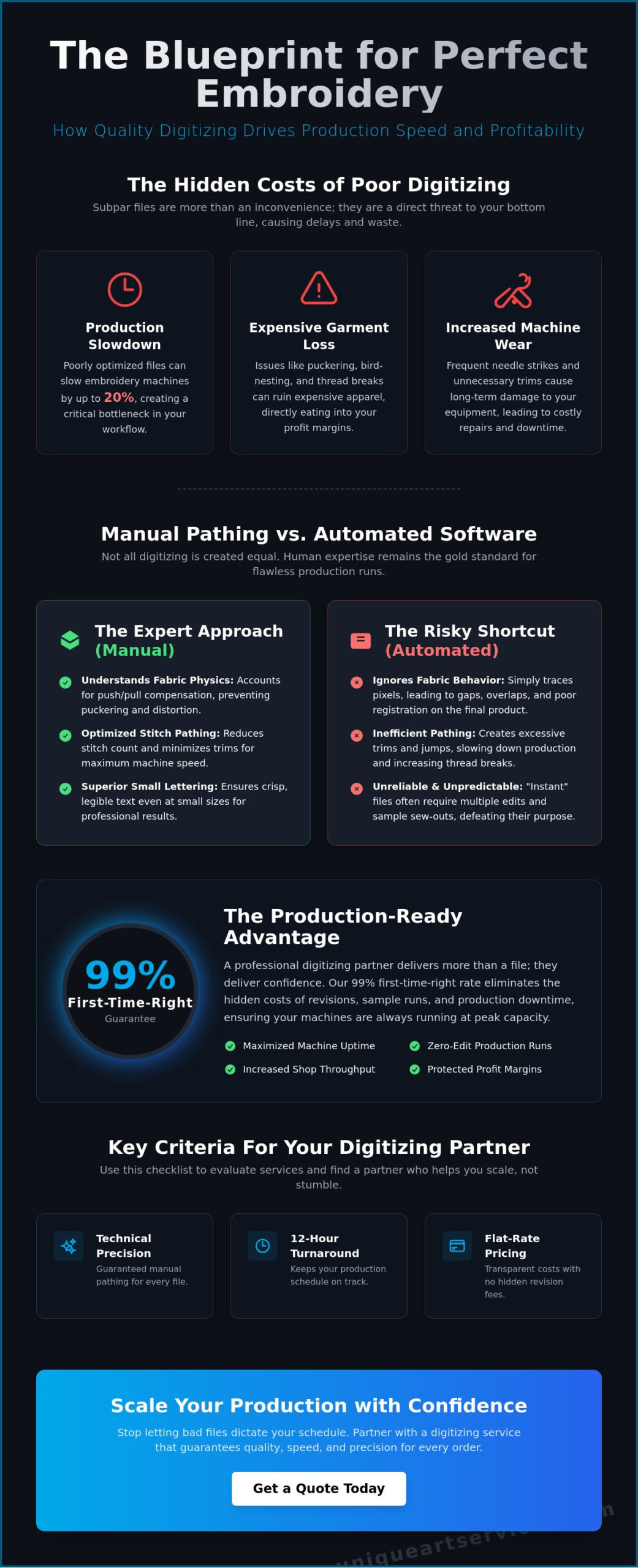
High-performance embroidery begins long before the first stitch is pulled through the fabric. While many shops view embroidery digitizing services as a simple graphic conversion, it’s actually the technical blueprint for your entire production line. A file that looks perfect on a computer screen can still cause havoc on the factory floor if it isn’t engineered for the physical realities of thread and tension. Poorly digitized files are known to slow down production by 15 to 20 percent, creating a bottleneck that ripples through your entire schedule.
Professional pathing is the art of sequencing stitches to minimize travel time and unnecessary trims. When a file is optimized, it reduces the total stitch count while maintaining the visual density required for a premium look. This efficiency is vital for high-speed multi-head machines. Every extra minute spent on a garment translates into lost capacity. Professional digitizers also account for “push and pull” factors. They adjust the design based on the specific substrate, whether it’s a structured cap or a stretchy performance polo. This level of detail ensures brand consistency, which is the primary requirement for corporate and B2B clients.
Modern computerized machine embroidery relies on these precise digital instructions to function at peak capacity. Without them, you risk frequent thread breaks, needle damage, and fabric spoilage that eats into your bottom line. Quality digitizing isn’t a graphic expense; it’s a production asset that keeps your machines running and your operators productive.
The “First-Time-Right” Advantage
In high-volume production, you don’t have time for multiple sample sew-outs or constant file revisions. A “first-time-right” rate of 99% should be your minimum standard for professional embroidery digitizing services. Expert technical analysis allows digitizers to anticipate how a design will behave on specific fabrics before the machine even starts. This precision reduces the need for physical samples and troubleshooting. It also protects your investment in hardware. Accurate files prevent the needle strikes and bird-nesting that cause long-term wear on your embroidery equipment.
Impact on Apparel Profit Margins
The true cost of “cheap” digitizing is often found in your waste bin. Saving a few dollars on a file is a poor trade-off if it results in a ruined $50 jacket or a needle snap that halts a multi-head machine. B2B clients demand perfection in logo replication. They won’t accept distorted lettering or visible fabric through the stitches. Delivering a crisp, clean result on the first run protects your margins and secures your reputation. By focusing on file quality, you increase your total shop throughput, allowing you to handle more orders without increasing your overhead.
Evaluating Technical Expertise: Manual Pathing vs. Automated Software
The rise of AI has led many to believe that high-quality embroidery digitizing services are now just a click away. In reality, automated software often struggles to interpret the complex relationship between thread, needle, and fabric. These tools frequently miss the nuances of design, leading to inefficient pathing that increases production time. Manual pathing remains the gold standard because it involves a human expert determining the exact sequence of every stitch. Manual digitizing is the intentional placement of every stitch for optimal machine flow.
Expert digitizers account for push and pull compensation, which is the natural tendency of fabric to shift under the pressure of the needle. Automated tools simply trace pixels, which results in gaps or overlapping stitches that ruin the garment’s finish. When you choose a partner, you’re looking for a specialist who understands how different textiles react during the production process. This level of technical depth is exactly what you’ll find when you partner with Unique Art Services for your production needs.
The Science of Stitch Direction
Stitch angles determine how light reflects off the finished design, creating the professional “sheen” that clients expect. A skilled digitizer carefully manages these angles to ensure a consistent look across the entire logo. This expertise is rooted in the same principles taught in a leading Textile Design program, where the interaction of materials and digital tools is a core focus. By strategically managing tension through smart pathing, experts prevent fabric puckering. They also select from various embroidery stitch types to add texture and depth that flat, automated files simply cannot replicate.
Small Lettering and Fine Detail
Physical thread has a fixed thickness, which makes small lettering particularly challenging. Automated software often clumps stitches together, causing “thread nesting” and broken needles. Success in digitizing small lettering for embroidery requires manual thinning and precise tie-ins. Professional digitizers know when to swap a standard satin stitch for a run stitch to maintain clarity in micro-details. This human intervention ensures that even the smallest copyright symbols or website URLs remain legible and production-friendly on high-speed machines. Reliable embroidery digitizing services prioritize this level of detail to eliminate the need for costly machine-side troubleshooting.
Key Criteria for Choosing an Embroidery Digitizing Partner
Selecting the right partner for your embroidery digitizing services requires a deep dive into their operational capabilities. A portfolio of beautiful images is a start, but it doesn’t tell you how those files will perform on a multi-head machine running at 1,000 stitches per minute. Compatibility is the first technical hurdle. Your partner must provide native support for industry-standard formats like DST, PES, and EXP. This ensures your equipment reads every instruction perfectly without the need for risky file conversions that can corrupt pathing data.
Scalability is a critical factor for growing shops. You need a partner who can handle 100+ designs per week during your peak production seasons without a dip in quality. This requires a robust infrastructure and a large team of seasoned experts. Communication is the final piece of the puzzle. You shouldn’t have to navigate a generic support ticket system. Reliable providers offer direct access to the technical digitizers handling your files. This allows for clear collaboration on complex project notes, such as specific layering for performance fabrics or high-detail logo adjustments.
Every file should undergo a multi-step quality assurance review before it reaches your inbox. This internal check identifies potential issues like excessive trims or incorrect stitch density before they ever reach your machine. By the time you receive the file, it should be ready for immediate production, protecting your shop’s uptime and efficiency.
Production-Ready File Standards
A professional delivery includes more than just the stitch file. When you evaluate different embroidery file types, ensure your provider also supplies a PDF proof and a detailed color chart. These documents are essential for your machine operators to set up thread sequences correctly. Precision digitizing also includes optimized trim settings to minimize manual post-production work. Furthermore, files must be tailored for their specific placement. A logo digitized for a flat left-chest won’t work on a structured cap, as the “push and pull” dynamics are entirely different. A true partner provides files optimized for the specific garment and location every time. Before submitting artwork, it’s also worth understanding the vector vs raster for logos distinction, as sending the correct file format ensures your digitizer can work from the highest-quality source art possible.
Global Support and Hubs
The global nature of the custom apparel market demands 24/7 coverage. Choosing a partner with service hubs in the US, UK, Canada, and Australia provides a significant time-zone advantage. This “follow-the-sun” model allows for overnight delivery; you can submit a design at 5:00 PM and have it ready for your morning production shift. This efficiency is only possible when you work with a firm that has 15+ years of industry-specific experience. This longevity proves they can navigate the shifting landscape of embroidery digitizing services while maintaining the high standards required by professional B2B clients.
Understanding Pricing and Turnaround: Balancing Speed with Precision
Budget predictability is a cornerstone of any profitable embroidery operation. When evaluating embroidery digitizing services, you’ll typically encounter two pricing models: flat-rate and stitch-count. Flat-rate pricing is often the preferred choice for professional shops because it eliminates the guesswork. You know exactly what each left-chest or cap logo will cost before you even submit the order. Stitch-count pricing can lead to “invoice shock,” where a design ends up significantly more expensive than your initial estimate. Transparent, upfront pricing allows you to quote your own customers with confidence and maintain your margins.
Speed is equally critical. A standard 12-hour turnaround has become the industry benchmark for high-capacity providers. This schedule allows you to intake customer artwork in the afternoon and have production-ready files waiting in your inbox by the next morning. However, you should also look for the availability of “free edits.” Some low-cost providers build these costs into a higher base price, while others charge for every minor adjustment. A partner that offers free technical revisions provides better long-term value, ensuring your final product meets your exact specifications without extra fees.
If you need immediate assistance with a high-priority project, you can order rush digitizing services to keep your production on track and meet even the most demanding client deadlines.
Managing Tight Deadlines with Rush Processing
Emergency jobs are a reality in the custom apparel world. Whether it’s a last-minute event or a late addition to a corporate order, you need a partner capable of 4-hour rush processing. High-tier embroidery digitizing services maintain dedicated teams for these same-day needs. The challenge is maintaining quality under pressure. Expert digitizers use proven templates and streamlined workflows to ensure that a rush file still meets the 99% first-time-right standard. This allows your 12-hour standard delivery to handle the bulk of your manufacturing while rush services act as your shop’s safety net.
The Myth of the “Cheapest” Digitizer
It’s tempting to choose a provider based on a $10 price point. However, a cheap file often becomes the most expensive part of your project. If a poorly digitized design causes a needle snap or ruins a $50 premium jacket, your actual cost has quintupled. Established firms provide better value through precision and additional services. For example, manual redraws in vector art conversion ensure that your companion screen-printing jobs match your embroidery perfectly. Furthermore, professional partners archive your designs, making re-ordering and minor scaling adjustments simple and efficient for years to come.
Scaling Your Production with Unique Art Services
Unique Art Services LLP functions as a seamless extension of your production team. We understand that your profitability depends on machine uptime and the total elimination of technical errors. By outsourcing your embroidery digitizing services to our specialists, you remove the bottleneck of file preparation and focus on what matters: finishing orders. Our 99% first-time-right guarantee is a commitment to your efficiency. It means you can load our files and start stitching without the need for troubleshooting or constant adjustments. This reliability is built on a foundation of technical precision and a deep understanding of high-speed manufacturing environments.
Our support extends beyond basic logos. We provide comprehensive design solutions, including high-precision vector art for companion print jobs. This ensures every aspect of your client’s brand remains consistent across different media. Starting your first project is a straightforward process designed for maximum speed. Simply submit your artwork through our secure portal to receive production-ready files within our standard 12-hour window. We’ve designed our system to integrate directly with your existing shop workflow, making the transition effortless for your staff.
Our Proven Workflow for Professional Results
Every design we handle undergoes a rigorous multi-stage journey. It begins with a technical analysis of your artwork and the intended fabric. Our experts then perform manual digitizing, placing every stitch with intention to ensure optimal machine flow. Finally, a dedicated quality control team reviews the file against your specific requirements. We specialize in complex requests that often trip up automated tools. Whether you need 3D puff for headwear, intricate appliqué, or specialized digitizing for fire-resistant garments, we have the expertise to deliver. We treat embroidery digitizing as a technical craft that requires both artistic vision and mechanical knowledge.
Ready to Eliminate Production Friction?
With over 15 years of industry-specific experience, Unique Art Services LLP has the global infrastructure to support shops of any size. Our service hubs provide the 24/7 coverage necessary to meet tight manufacturing deadlines across the US, UK, Canada, and Australia. We offer a standard 12-hour delivery window and a 4-hour rush option for those critical, same-day production needs. We’ve optimized every step of our process to ensure you receive the highest quality embroidery digitizing services without the typical stress of outsourcing. You can trust our seasoned experts to handle the fine details while you scale your business.
Optimize your embroidery production with Unique Art Services today.
Future-Proofing Your Embroidery Production for 2026
Success in the 2026 custom apparel market requires more than just high-speed machines; it demands technical precision at the file level. We’ve explored how manual pathing outperforms automated software by accounting for real-world fabric physics. Choosing professional embroidery digitizing services that prioritize this “first-time-right” approach is the only way to eliminate production friction and protect your shop’s profit margins. By focusing on machine-ready files and transparent pricing, you turn your digitizing partner into a strategic asset rather than a simple overhead cost.
Unique Art Services LLP brings over 15 years of industry experience to your production line. With a 99% first-time-right rate and dedicated hubs in the US, UK, Canada, and Australia, we ensure your equipment never sits idle. Whether you need a standard 12-hour delivery or a 4-hour rush order for an emergency job, our team is ready to deliver. It’s time to stop fighting with poor quality files and start scaling your business with confidence.
Get Production-Ready Files in 12 Hours with Unique Art Services and experience the difference of professional manual digitizing.
Frequently Asked Questions
What should I look for in a professional embroidery digitizing service?
You should prioritize technical expertise in manual pathing, a high first-time-right rate, and the ability to scale with your production volume. A reliable provider offers 24/7 global support and transparent, flat-rate pricing to ensure budget predictability. It’s also essential to have direct access to technical digitizers who can interpret complex project notes and fabric-specific requirements for your high-speed machines.
How long does it typically take to get a logo digitized for embroidery?
The industry standard for professional turnaround is 12 hours. This schedule allows your shop to submit artwork at the end of the day and receive production-ready files by the next morning shift. For emergency manufacturing needs, some embroidery digitizing services offer rush processing that delivers files in as little as 4 hours without sacrificing the technical precision required for machine uptime.
Can I use automated software instead of a professional digitizing service?
Automated software is generally unsuitable for commercial production because it lacks human judgment regarding fabric physics. While AI tools can trace pixels, they don’t account for push and pull compensation or stitch direction. Professional services ensure your files are engineered for specific substrates, preventing the thread breaks, puckering, and needle snaps that are common with automated “instant” files.
What file formats will I receive from an embroidery digitizer?
You’ll receive industry-standard machine formats such as DST, PES, or EXP, depending on your equipment’s requirements. A professional delivery also includes a PDF proof and a detailed color chart. These documents are vital for your machine operators. They allow your team to verify stitch counts, trim settings, and thread sequences before the first needle drops on a garment.
Why is manual pathing important for my embroidery machine?
Manual pathing dictates the exact sequence and direction of every stitch, which directly impacts your shop’s efficiency. It minimizes unnecessary trims and travel time, reducing the total stitch count without losing visual density. This intentional engineering prevents “bird-nesting” and ensures that high-speed multi-head machines run at peak performance with minimal operator intervention or troubleshooting.
What happens if my digitized file needs a size adjustment or edit?
Professional services typically offer technical revisions to ensure the design meets your exact production standards. Minor size adjustments, usually within a 10 to 20 percent range, are handled quickly to maintain proper stitch density and clarity. You should choose a partner that archives your designs, making it easy to request edits or re-order files for repeat clients years later.
How do rush embroidery digitizing services work?
Rush services prioritize your project in a dedicated high-speed queue to meet same-day manufacturing deadlines. Once you submit the artwork, it’s assigned to a senior digitizer who maintains quality standards while working within a 4-hour window. This service acts as a safety net for last-minute corporate orders or event-driven schedules that cannot wait for the standard 12-hour delivery cycle.
Is there a difference between digitizing for hats vs. flat garments?
Yes, the technical requirements differ significantly due to the curved surface and center-seam of headwear. Digitizing for caps requires a “center-out” pathing strategy to prevent shifting and registration issues. Flat garments, such as polos or jackets, use standard push and pull compensation. High-quality embroidery digitizing services always ask for the garment type to adjust stitch angles and density correctly for the specific substrate.