Custom Logo Design for Embroidery: Engineering Your Brand for Thread and Needle
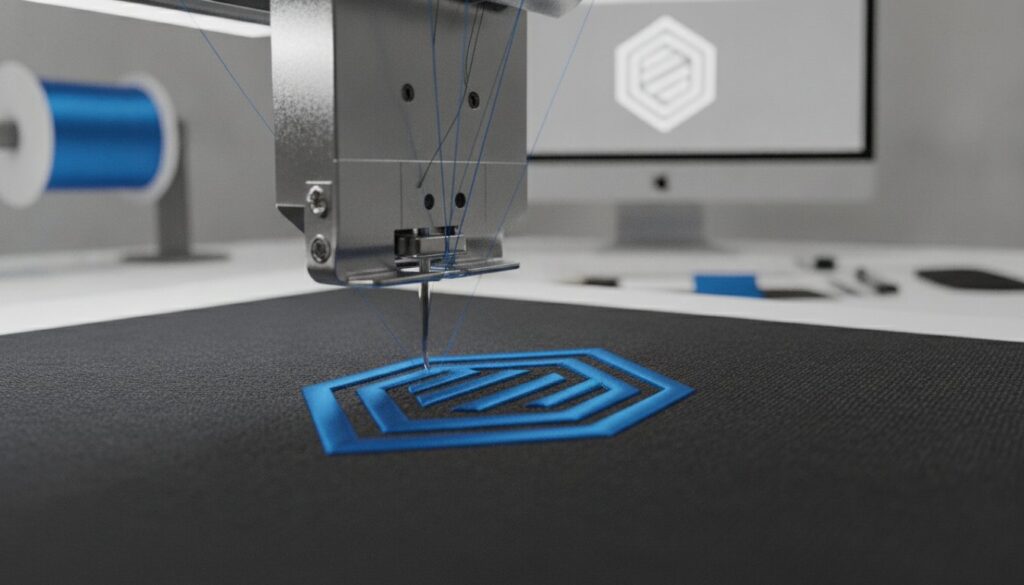
Your digital logo might look flawless on a high-resolution monitor, but the physical reality of a needle and thread is far less forgiving. Most branding fails the transition to fabric because it wasn’t engineered for the specific physics of an embroidery machine. Mastering custom logo design for embroidery requires moving beyond aesthetics and into the realm of production logic. When fine lines disappear or small text becomes an illegible knot, it’s usually a sign that the digital art hasn’t been optimized for the medium.
It’s common to feel frustrated when a beautiful design leads to high production costs or unsightly fabric puckering. You expect your brand to look premium on every polo and cap, yet the technical constraints of thread often stand in the way. This guide changes that by teaching you how to design specifically for physical production. We will explore how to simplify complex elements, manage stitch density, and create scalable art that ensures a professional finish. By the end, you’ll have a clear path to reducing costs and achieving faster turnarounds for all your branding projects.
Key Takeaways
- Transition from digital pixels to physical thread by understanding how additive layers affect the final garment appearance.
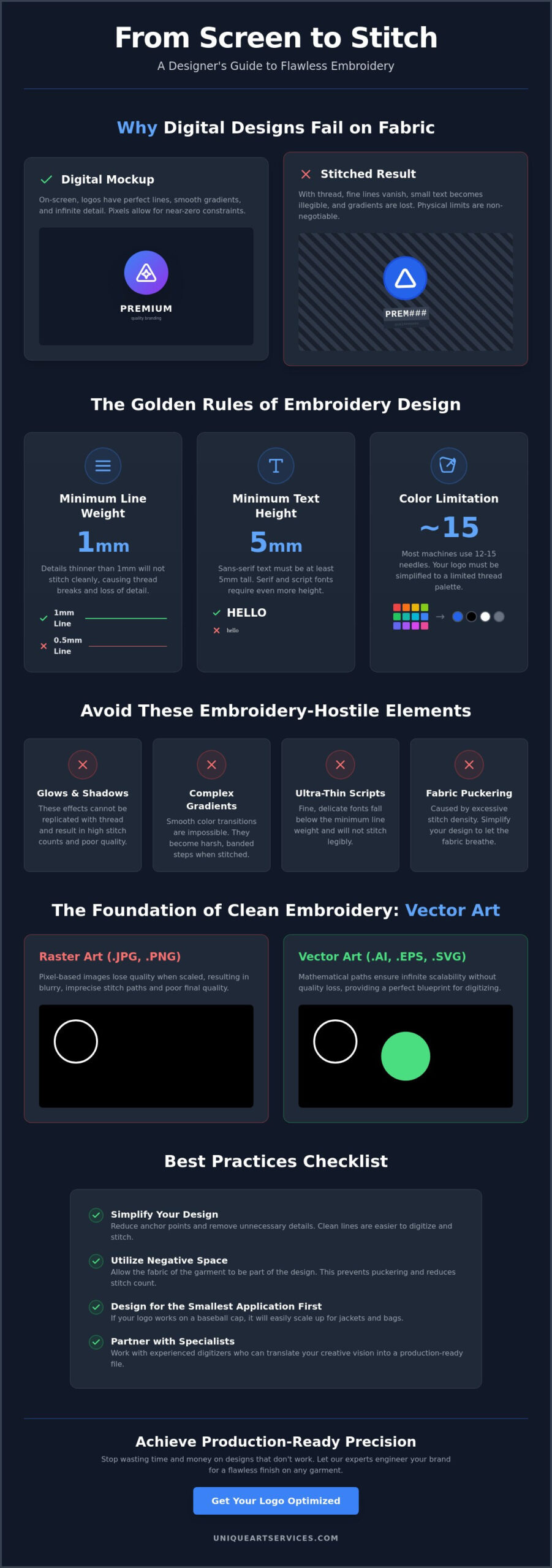
- Master essential technical constraints, such as the 1mm line weight and 5mm text rules, to ensure your custom logo design for embroidery is production-ready.
- Identify and remove “embroidery-hostile” elements like glow effects or ultra-thin scripts that lead to high stitch counts and fabric puckering.
- Utilize high-quality vector art as the foundation for all digitizing to maintain precision and scalability across different apparel types.
- Partner with experienced specialists to optimize designs for specific placements, ensuring clean results while significantly reducing total production costs.
Why Custom Logo Design for Embroidery Requires a Different Approach
Designing a logo for a website or a business card is a creative exercise. Designing a custom logo design for embroidery is an engineering challenge. On a screen, colors are formed by additive light, and pixels can be scaled to near-infinity without physical consequence. In the physical world, we work with thread that has a fixed thickness and needles that must pierce fabric thousands of times. A “digital-first” logo often fails when translated to a left-chest polo because it ignores these rigid physical boundaries.
Thread vs. Pixels: Understanding the Medium
Pixels don’t have texture, but thread does. When you view a logo on a smartphone, the surface is perfectly flat. In computerized machine embroidery, the direction of the stitches changes how light reflects off the garment. This means a single shade of blue thread can look like two different colors depending on the stitch angle. Understanding this interaction is vital for creating a design that maintains its integrity under different lighting conditions.
Thread also has a physical footprint. While a graphic designer can create a digital line that is 0.1mm wide, a standard embroidery needle cannot replicate it effectively. If a design is too dense, the fabric becomes stiff and uncomfortable, a phenomenon often called “bullet-proofing.” Successful designs utilize negative space, allowing the garment fabric to breathe between embroidered elements. This approach maintains the drape of the clothing while ensuring the logo remains crisp and professional.
The Production-First Mindset
Professional designers start with the most difficult application in mind. Usually, this is a baseball cap. Caps have limited real estate and a curved surface that causes fabric to shift during production. If your custom logo design for embroidery works on a structured hat, it will easily scale to a fleece jacket or a tote bag. Designing for the smallest, most restrictive surface first ensures that your brand remains legible across all media.
This process requires anticipating “pull compensation.” As the needle pulls the thread, it naturally tugs the fabric inward. Experienced designers adjust their initial sketches to account for this distortion before the file ever reaches a machine. This technical translation is known as logo digitizing. It serves as the essential bridge between a creative vision and a production-ready file, ensuring that circles stay circular and lines stay straight once they’re stitched.
Complexity directly impacts your bottom line. Every extra detail adds to the stitch count. Higher stitch counts require more machine time and more thread, which increases your per-piece production cost. By engineering your brand for the needle from day one, you reduce overhead and guarantee a cleaner, more professional result that is easy to reproduce at scale.
Technical Constraints: Designing for Stitchability and Production Success
Precision in a custom logo design for embroidery isn’t measured in pixels, but in the physical width of a needle and the diameter of the thread. While digital art allows for microscopic details, the embroidery machine has strict physical limits. If a designer ignores these constraints, the result is often a messy, unprofessional garment that costs more to produce. Efficiency begins with understanding the specific tolerances of the medium.
Minimum line weight is the most critical technical barrier. Any detail thinner than 1mm usually disappears or causes the needle to strike the same spot too many times, leading to thread breaks and holes in the fabric. Similarly, small text requires a disciplined approach. We follow the “5mm rule,” which dictates that sans-serif letters should be at least 5mm tall to remain legible. Scripts and serif fonts often need even more space to prevent the “holes” in letters like ‘e’ or ‘a’ from closing up entirely. Simplifying your shapes by reducing anchor points in your vector file also creates a cleaner path for the digitizer to follow.
Color Management for Embroidery
Most industrial embroidery machines operate with 12 to 15 needle heads. While digital designs can utilize millions of colors, your physical logo must be limited to a manageable palette. This constraint actually helps maintain brand consistency. You’ll need to translate your Pantone or Hex codes into specific thread brands like Madeira or Isacord. High-contrast colors are vital for visibility, especially when working with textured fabrics like pique polos or high-pile fleece. Applying classic design principles regarding contrast and balance ensures your logo stands out rather than sinking into the garment’s texture.
Fabric-Specific Design Adjustments
A logo designed for a flat tote bag won’t necessarily work on a structured baseball cap. Caps require a “center-out” stitching pattern to account for the curve of the hat. This often means the design must be slightly more robust to handle the tension. For delicate fabrics like silk, we reduce stitch density to prevent the material from puckering. Conversely, heavy canvas requires a strong underlay stitch to stabilize the custom logo design for embroidery and provide a foundation for the top stitches. If you’re unsure if your current art meets these technical specs, our team can provide a professional logo design audit to ensure your project is production-ready from the start.
Digital gradients present another significant challenge. Smooth fades on a screen are achieved by blending pixels, but in embroidery, gradients require complex “color blending” where different thread colors are layered on top of each other. This increases the stitch count and production time significantly. In most cases, we recommend using solid colors or halftones to achieve a similar effect without the technical overhead.
Vector Art Conversion: The Foundation of Clean Embroidery
While previous sections detailed the physical tolerances of thread, the source file remains the most common point of failure in the production chain. Raster images like JPEGs or PNGs are composed of a fixed grid of pixels that blur when enlarged or modified. For a custom logo design for embroidery, this lack of definition is catastrophic. The embroidery machine requires clear, mathematical borders to determine exactly where a needle should drop. Blurry edges in a raster file lead to jagged stitch paths and inconsistent borders that undermine your brand’s professional image.
Understanding the distinction between vector vs raster graphics is a critical requirement for brand owners. Vector art uses mathematical coordinates to define shapes, ensuring that a logo remains perfectly sharp whether it is scaled for a tiny sleeve hit or a massive jacket back. By respecting the elements of fashion design—specifically the integrity of line and shape—you ensure the digital foundation is strong enough to support the physical weight of the thread.
The Vector-to-Stitch Pipeline
Clean vector paths are the prerequisite for efficient embroidery digitizing. When a vector file is built correctly, the digitizer can focus on stitch direction and density rather than repairing broken artwork. It is essential to remove overlapping paths in your vector file; these hidden layers create clusters of stitches that cause needle breaks and uncomfortable, stiff designs. To maintain this mathematical precision, always provide files in AI, EPS, or PDF formats, as these are the industry gold standards for production-ready art.
Manual Redrawing for Precision
Automated tracing tools often create erratic lines and thousands of redundant anchor points that confuse the embroidery machine. These software-generated shortcuts result in wobbly curves and inconsistent corners that look amateurish once stitched. At Unique Art Services LLP, we utilize a manual redrawing process to ensure 99%+ accuracy. We hand-trace every curve to rebuild low-resolution source files into geometrically perfect “master” assets. This expert intervention ensures symmetry and sharp corners that auto-trace tools miss, providing the most stable foundation possible for a custom logo design for embroidery.
Investing in manual vectorization eliminates the technical friction between your creative vision and the final garment. A hand-drawn vector file serves as a permanent, scalable asset for all future branding needs. It guarantees that every stitch is purposeful and that your production costs remain optimized through clean, efficient needle paths.
Best Practices for Embroidery-Ready Branding
Auditing your brand identity is the first step toward a successful custom logo design for embroidery. Many digital logos contain elements that simply don’t translate to thread. We call these “embroidery-hostile” features. Glow effects, drop shadows, and ultra-thin scripts look great on a website but become a chaotic mess of overlapping threads on a shirt. By identifying these issues early, you save time and prevent expensive production errors.
The left-chest placement remains the industry standard for corporate apparel, yet it’s also the most challenging. You’re typically working within a 3.5-inch to 4-inch wide window. In this small space, every stitch counts. If your logo is too busy, it will cause the fabric to bunch. Professional designers often create a simplified “embroidery version” of a logo that retains the brand’s essence while removing non-essential details. This ensures a clean, professional look on every polo.
Choosing the right stitch type is equally important. Satin stitches are ideal for text and borders, providing a high-sheen, premium finish. However, they shouldn’t exceed 12mm in length, or they’ll become loose and snag. For larger areas, we use fill stitches. These are flatter and more durable, but they require careful density management to keep the garment flexible. Always request a “sew-out”, which is a physical test on a scrap of similar fabric, before committing to a full production run. It’s the only way to verify the design’s integrity.
Simplifying for Impact
Use the “Squint Test” to evaluate your design. If you can’t distinguish the main elements while squinting, the embroidery machine won’t either. Removing thin outlines often improves clarity significantly. These outlines add bulk and increase the stitch count without adding visual value. Consider using “Negative Space” designs. By letting the color of the fabric act as part of the logo, you reduce thread density and create a more breathable, modern garment.
Preparing for the Digitizer
To ensure your vision is realized, you must provide clear instructions to your digitizing partner. Specify the exact garment type and the desired final dimensions. This helps the specialist convert logo to embroidery file formats like DST. The DST file is the universal language of embroidery machines, containing every needle movement and trim command. Accurate instructions prevent the need for multiple revisions and keep your project on schedule.
Ready to streamline your branding? Partner with our expert logo design team to create a production-ready asset that looks perfect on every stitch.
Partnering with Specialists for Production-Ready Logo Design
Engineering a brand for thread is a specialized discipline that bridges the gap between digital art and physical manufacturing. While previous sections detailed the technical rules of stitchability, implementing those rules requires a partner who understands the physical manufacturing environment. Unique Art Services LLP brings over 15 years of technical experience to every custom logo design for embroidery, predicting exactly how a needle will interact with different fabric densities before production begins. This specialized expertise prevents the common pitfalls of thread breaks and fabric distortion that often plague generalist design firms.
Efficiency at scale is a hallmark of our operations. Unique Art Services LLP functions as a global specialist, providing high-capacity design fulfillment for businesses of all sizes. With dedicated service hubs in the US, UK, Canada, and Australia, we provide a seamless experience across international markets. We understand that branding projects often operate on tight deadlines. To support your business objectives, we provide a standard 12-hour turnaround on most projects. For urgent requirements, our 4-hour rush order processing ensures your production line never stops moving.
The Unique Art Services LLP Workflow
Our process begins with a rigorous technical analysis of your artwork. We don’t just redraw your art; we analyze its stitchability based on your specific garment choice. Every custom logo design for embroidery undergoes a multi-step Quality Control check. This methodical approach allows Unique Art Services LLP to maintain a 99%+ first-time-right rate, saving you from the frustration of multiple revisions. This precision is achieved through manual artistry. We avoid automated shortcuts because they cannot replicate the nuanced decision-making of a seasoned digitizer who knows how to map needle paths for maximum clarity.
Ready to Digitize Your Vision?
Starting your project is a straightforward process designed to remove friction from your creative workflow. Unique Art Services LLP offers flat-rate digitizing fees for our services, providing you with transparent budgeting and predictable costs for every order. Whether you need a completely new logo design or want to optimize an existing asset for apparel, our team acts as a reliable backbone for your commercial enterprise. We handle the technical complexities of thread and needle so you can focus on growing your brand. Get your production-ready custom logo design from Unique Art Services LLP today.
Elevate Your Branding with Production-Ready Design
Bridging the gap between a digital sketch and a finished garment requires more than just aesthetic vision. By understanding the physical medium of thread, you ensure your branding remains legible and professional across all apparel types. We have explored the necessity of a production-first mindset, the technical tolerances of needles, and the critical role of manual vectorization in preventing common production bottlenecks.
Your organization deserves a custom logo design for embroidery that is engineered for precision from the start. Unique Art Services LLP provides the stability and technical expertise needed to handle high-volume branding projects with ease. With over 15 years of industry experience and a 99%+ first-time-right accuracy rate, we remove the guesswork from your creative process.
Efficiency is built into our workflow with a standard 12-hour turnaround. Order Your Production-Ready Logo Design Now to secure a professional finish for your next apparel project. We are ready to help you transform your brand into a tangible, high-quality asset that lasts as long as the garment itself.
Frequently Asked Questions
Can any logo be used for embroidery?
No, not every design is suitable for thread and needle without modification. Many digital-first logos contain microscopic details or complex overlapping elements that the physical medium cannot replicate. A successful custom logo design for embroidery requires simplified shapes and bold lines. This ensures the needle can recreate the image accurately without damaging the fabric or creating an illegible, bulky mess of thread.
What is the best file format for embroidery logo design?
Vector files such as AI, EPS, or PDF are the industry gold standard. These formats use mathematical paths instead of pixels, allowing your logo to be scaled to any size without losing resolution. While raster images like JPEGs are common, they often lack the sharp edges needed for precise digitizing. Providing a clean vector file gives the digitizer a perfect blueprint to map out every stitch path.
Why does my logo look different on a hat than on a shirt?
Different surfaces and garment structures require unique stitching patterns. Hats have a curved, rigid surface that needs a center-out stitching sequence to prevent the fabric from shifting during production. Shirts are flat and flexible, which allows for different density settings and underlay choices. These physical variations change how the thread sits on the material, making specific design adjustments necessary for each garment type.
How small can text be in an embroidered logo?
Legibility is limited by the fixed thickness of the thread and the diameter of the needle. We generally recommend a minimum height of 5mm for sans-serif block fonts to ensure the letters remain crisp and readable. Serif or script fonts often require even more space to prevent the loops from closing up. If text is smaller than these limits, it will likely become an illegible knot during production.
What is the difference between logo design and logo digitizing?
Logo design is the creative process of developing your visual brand identity. Logo digitizing is the technical engineering process of converting that artwork into a command file, such as a DST, that an embroidery machine can read. While the design focuses on aesthetics and brand messaging, digitizing focuses on needle paths, stitch directions, and density management to ensure the art translates perfectly to fabric.
How much does it cost to have a logo designed for embroidery?
Total costs typically depend on the complexity of the artwork and the total stitch count required for production. Intricate designs with many color changes or high-density fills require more labor and machine time than simple, minimalist logos. While there is often a one-time setup fee for the initial digitizing, the per-piece cost is influenced by the volume of garments and the specific material being used.
Why should I avoid gradients in my embroidery logo?
Thread is a solid, physical medium that does not blend as naturally as digital pixels on a screen. Creating a smooth gradient requires complex color blending, where different thread colors are layered on top of each other. This process significantly increases the stitch count and production time. For the most professional results and lower costs, it is better to use solid colors or simplified halftones in your design.
How long does it take to get a logo ready for production?
Efficiency is a core part of our service model. Most custom logo design for embroidery projects are completed within our standard 12-hour turnaround window. If your branding project has an urgent deadline, we also provide 4-hour rush processing options. This rapid delivery ensures your production-ready files are back in your hands quickly, allowing your apparel project to stay on schedule without any technical delays.