Pro Digitizing: Scaling Your Embroidery Shop with Production-Ready Designs
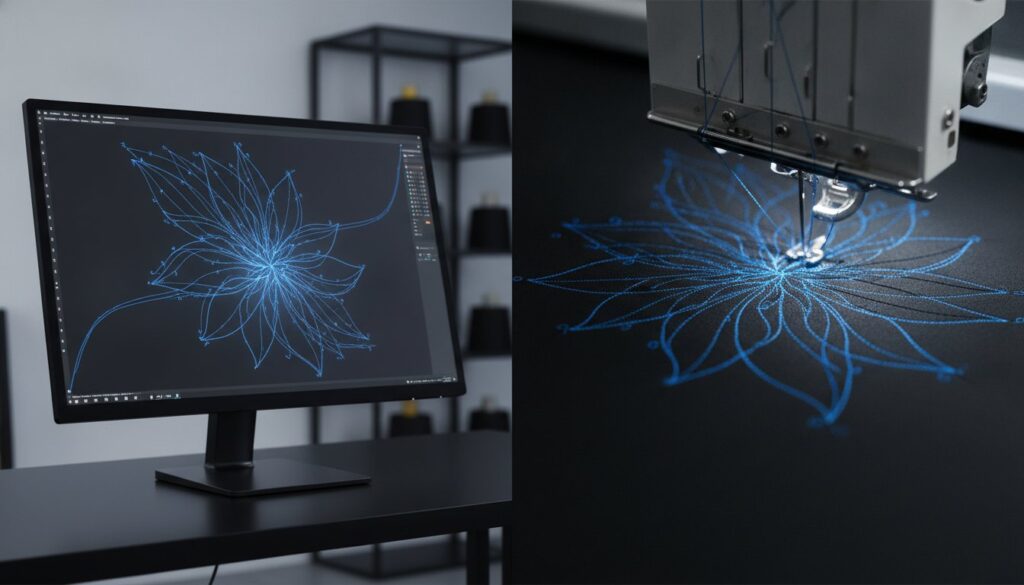
Your embroidery machine is only as profitable as the file you feed it. You’ve likely experienced the frustration of a design that looks perfect on screen but turns into a mess of thread breaks and “bird-nests” once the needles start moving. It’s exhausting to watch your production schedule slip because of a poorly digitized file that requires constant babysitting. When you invest in pro digitizing, you’re not just buying a file conversion; you’re securing a manufacturing blueprint that dictates your daily output.
We understand that missed deadlines and machine downtime are the biggest threats to your growth. That’s why we’re showing you how professional, production-ready designs can eliminate these technical bottlenecks. You’ll discover how to scale your embroidery business without increasing your overhead or your stress levels. We will look at the benefits of a first-time-right partner who delivers rapid turnarounds under 12 hours, ensuring your industrial machines run smoothly from the very first stitch.
Key Takeaways
- Learn how manual pathing prevents inefficient jump stitches and ensures a logical, continuous machine flow.
- Understand the technical difference between simple file conversion and pro digitizing as a specialized manual craft.
- Discover strategies to scale your production and reduce overhead by outsourcing technical design to a high-capacity partner.
- Identify the critical benchmarks for a digitizing partner, such as 15+ years of experience and 4-hour rush order capabilities.
- Master a 4-step workflow that integrates analysis and quality checks to guarantee production-ready results every time.
What is Pro Digitizing? Defining Quality in Embroidery Data
Pro digitizing is the specialized manual process of mapping stitch paths for industrial embroidery machines. It’s far more complex than simply clicking a button in a software program. While a graphic designer works in a flat, two-dimensional space, a digitizer must translate that artwork into a physical medium of thread and tension. This transition requires a deep understanding of how different materials react under the needle. It’s an engineering task as much as a creative one.
A professional file acts as a technical blueprint for your equipment. It dictates every move the machine makes, from the speed of the stitches to the sequence of the colors. High-quality digitizing accounts for the “push and pull” factors. This is the physical reality that thread pulls the fabric inward while the needle pushes it outward. Without precise compensation for these forces, designs often end up misaligned or distorted. Pro digitizing ensures that the final product matches the original vision, regardless of the fabric choice.
Beyond the File Format: The Production Blueprint
A DST or EMB file is only a container. Its true value lies in the designer’s pathing logic. Professional digitizers organize the sequence of stitches to minimize jump stitches and trims. This keeps the machine running at peak efficiency. They also adjust density settings based on the substrate. A design for a heavy canvas bag requires different stitch density than a design for a lightweight performance tee to prevent fabric puckering. Pro digitizers optimize for specific garment types by using techniques like:
- Center-out pathing: Essential for hats to ensure the design stays crisp and centered without shifting.
- Underlay stabilization: Building a foundation of stitches to prevent the design from sinking into fleece or knits.
- Small lettering optimization: Adjusting stitch types to ensure text remains legible at micro-scales.
Why Machine Shops Outsource to Professional Experts
Successful embroidery shops focus on production volume. Technical design often becomes a bottleneck that slows down the floor. By outsourcing to experts, shop owners can scale their workflow without the burden of hiring and training full-time staff. They gain immediate access to specialized skills for complex tasks like 3D puff embroidery or ultra-small lettering that standard automated software cannot handle accurately. This approach maintains a lean overhead. You pay per design rather than managing a fixed salary. It allows your business to remain agile during fluctuating seasons while ensuring every file that hits your machines is production-ready.
Manual Pathing vs. Auto-Digitizing: The Professional Standard
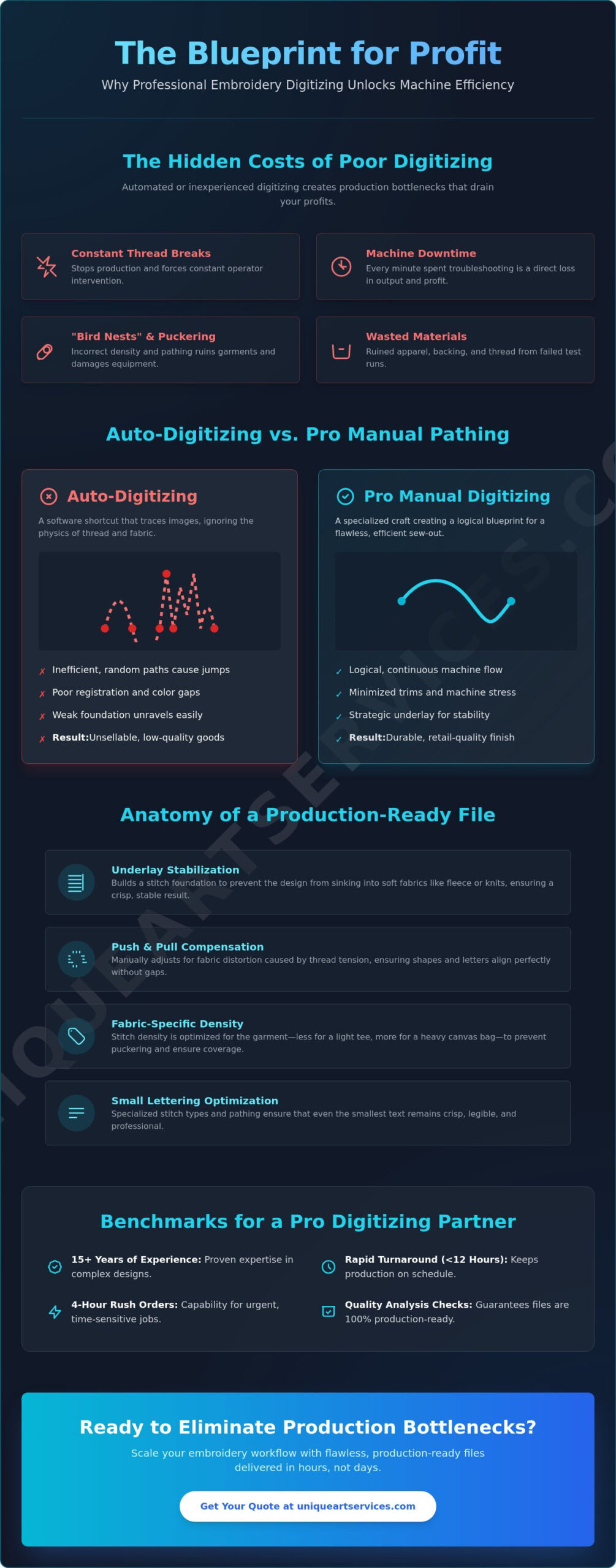
Auto-digitizing software is a tempting shortcut, but it often creates a production nightmare. These automated tools use algorithms to trace the edges of an image without understanding the physical journey of the needle. This results in inefficient paths filled with excessive jump stitches and unnecessary trims. A professional digitizer, however, approaches the design with a “logical flow.” They plan the sequence so the machine moves smoothly from one element to the next, reducing the mechanical stress on your equipment and speeding up the sew-out time.
The “pro” difference is most visible the moment you flip the garment over. A manually digitized file results in a clean, organized underside with minimal knots and loose ends. This isn’t just about professional pride. It’s about the comfort of the wearer and the structural integrity of the embroidery. Professional designers manually set tie-ins and tie-offs to secure the thread at the start and end of every segment. Automated software frequently ignores these critical steps, leading to designs that unravel after just a few cycles in the wash.
The Hidden Costs of Automated Tracing Tools
Software-generated files are often the primary cause of frequent thread breaks. Every time a thread snaps, your machine stops, and your operator loses minutes re-threading and troubleshooting. These interruptions represent a significant drain on your daily output. Automated tools also struggle with registration, where colors fail to line up correctly. This creates gaps or awkward overlaps that ruin the garment. You end up wasting expensive consumables like backing and thread, not to mention the cost of the ruined apparel itself, on failed test runs that could have been avoided with a high-quality file. Using an embroidery digitizing quality checklist can help you identify and avoid these costly pitfalls when evaluating any digitizing service.
Precision Stitch Placement and Underlay Strategy
Every retail-quality design requires a solid foundation. Manual underlay provides this stability by tacking the fabric to the stabilizer before the decorative top stitches are applied. Professional designers also manipulate stitch angles to create depth and control how light reflects off the thread. This level of detail is what gives embroidery its premium, three-dimensional feel. By optimizing stitch counts, a pro digitizing expert ensures the design is dense enough to look rich but light enough to maintain fabric drape. Finding this technical balance is why many successful shops choose to partner with specialized design experts for their production files.
Strategic Business Benefits of Professional Digitizing Services
Switching to a professional workflow transforms your embroidery shop from a reactive operation into a high-efficiency production house. While technical precision is the foundation, the true value of pro digitizing lies in your bottom line. Every minute your machine isn’t running is a minute you aren’t generating revenue. By using files designed specifically for industrial speed, you move past the “trial and error” phase of production and go straight to the finished product. This shift allows you to focus on high-level business growth rather than daily technical troubleshooting.
Efficiency doesn’t just mean speed; it means consistency. When your designs are crisp and retail-ready on the first run, customer satisfaction scores rise. This reliability builds a stable reputation in a crowded market, making it easier to secure lucrative B2B contracts that demand high volume and tight tolerances. Professional files reduce the “re-run” cycle that eats into your margins, ensuring that your thread, backing, and labor costs are optimized for every single order.
Reducing Machine Downtime and Thread Breaks
There is a direct correlation between the quality of your digitizing and the longevity of your equipment. Files that are over-dense or poorly pathed force your machines to work harder, leading to premature wear on needles, hooks, and motors. Clean, manually pathed designs reduce the need for constant operator intervention. Instead of “babysitting” a single-head machine to catch frequent thread breaks, your staff can manage multiple heads simultaneously. This significantly lowers your per-unit labor costs and maximizes your total daily output without requiring additional hires.
Scaling Capacity Without Increasing Overhead
Peak seasons often create a bottleneck that forces shops to turn away work or pay expensive overtime. Partnering with a global design hub provides instant scalability. With a standard 12-hour turnaround for most designs, you can accept last-minute orders with total confidence. Leveraging 24/7 design support means your files are ready the moment your morning shift starts. Unique Art Services maintains a 99%+ first-time-right design rate, which is critical for high-volume shops that cannot afford the delay of multiple revisions. This external support acts as an extension of your team, allowing you to scale your design capacity to meet any demand without the fixed cost of full-time in-house digitizers.
Evaluating Technical Excellence: What to Look for in a Pro Partner
Selecting a partner for pro digitizing is a decision that directly impacts your shop’s reputation and machine health. It’s essential to look beyond surface-level marketing and verify the provider’s industry tenure. A company with 15+ years in the industry has seen every possible fabric challenge and machine quirk. This longevity suggests they have a proven system for quality control that isn’t found in newer operations. You also need a partner that understands the full creative spectrum. A provider that offers both embroidery digitizing and vector art conversion allows you to handle every client request under one roof, maintaining brand consistency across different products.
Turnaround Times and Rush Order Capabilities
Modern fulfillment demands speed. While many competitors offer “next day” service, a 12-hour standard is the minimum requirement for a truly competitive shop. The real differentiator is the availability of 4-hour rush processing. These ultra-fast options are vital for securing high-value contracts where the client needs a sample or a small run finished immediately. Global service hubs make this possible by using time-zone differences to their advantage. When you send a file at the end of your business day, a global team can have it ready by the time your morning shift arrives. This 24/7 support cycle keeps your production floor active and your clients impressed with your responsiveness.
Multi-Format Support and Production Standards
Compatibility is non-negotiable. Your pro digitizing partner must deliver files that work seamlessly with Tajima, Barudan, and Brother machines. This requires expertise in formats like DST, PES, and EXP. However, receiving a file is only half the battle. A professional partner provides a technical analysis with every design. This analysis acts as a blueprint for your machine operators. It should include precise stitch counts, color sequences, and specific stabilization recommendations for the chosen fabric. This level of detail prevents errors before they happen. To better understand the technical requirements of different machines, refer to this Comprehensive Guide to Embroidery File Types.
Technical excellence is the backbone of a successful embroidery business. If you need a partner that delivers precision and speed, contact us to start your next project.
Scaling Your Workflow with Unique Art Services
Unique Art Services acts as the stable backbone for your embroidery shop. With over 15 years of industry experience, we provide the technical precision required to handle high-volume production without the friction of constant revisions. Our global reach, spanning hubs in the US, UK, Australia, and Canada, ensures that your shop has access to expert design support regardless of your time zone. This infrastructure allows you to scale your operations instantly, turning technical design from a bottleneck into a competitive advantage.
We operate with a methodical 4-step workflow designed for total transparency and predictability. Every project follows a disciplined sequence to ensure your machines never stop running:
- Analysis: We review your artwork and garment type to determine the optimal stitch strategy and density settings.
- Manual Digitizing: Our experts perform manual pathing to ensure logical flow, durability, and minimal jump stitches.
- Quality Check: Every file undergoes a rigorous review against our internal production standards before it leaves our desk.
- Rapid Delivery: Your production-ready file is delivered within your specified timeframe, ready to be loaded onto your machines.
15 Years of Precision: Our 99% Accuracy Rate
Our commitment to a 99% accuracy rate isn’t just a statistic. It’s a promise that your machines will stay running and your deadlines will be met. We achieve this through a manual redrawing process that captures the fine details automated tools miss. This “first-time-right” methodology eliminates the need for repeated test runs and reduces material waste. When you use our pro digitizing services, you receive a file that has been engineered for the physical realities of thread and fabric. For a deeper look at these technical standards, read more in The Ultimate Guide to Professional Embroidery Digitizing.
From 12-Hour Standard to 4-Hour Rush Delivery
We understand that the embroidery industry moves fast. Our standard 12-hour turnaround is designed for high-volume efficiency, but our dedicated rush team can meet impossible deadlines with 4-hour delivery options. We utilize flat-rate fees to simplify your project estimation. This transparency allows you to quote your clients accurately without worrying about hidden design costs or fluctuating per-stitch pricing. Whether you’re handling a single custom cap or a 1,000-piece corporate order, our design team provides the stability you need to grow. Start your first project with Unique Art Services today and experience the difference of production-ready design.
Future-Proof Your Embroidery Production
Transitioning to a professional workflow is the most effective way to eliminate machine downtime and reclaim your production schedule. High-quality pro digitizing isn’t just about a pretty design; it’s a technical blueprint that protects your equipment and maximizes your output. By moving away from inefficient automated software and embracing manual pathing, you ensure every stitch serves a purpose. This precision allows your shop to handle higher volumes without the need for additional staff or constant machine monitoring.
Unique Art Services brings 15+ years of industry experience to your production floor. We maintain a 99% first-time-right rate to ensure your machines stay running from the moment you load a file. Whether you need our 12-hour standard turnaround or our ultra-fast 4-hour rush processing, we’re here to help you meet even the most demanding client deadlines. It’s time to stop troubleshooting and start growing your business with total confidence.
Get Your Production-Ready Design in as Little as 4 Hours
Frequently Asked Questions
What is the difference between pro digitizing and auto-digitizing?
Pro digitizing is a manual craft where an expert maps every stitch path to account for fabric tension and machine movement. Auto-digitizing relies on software algorithms that often produce excessive jump stitches and inefficient paths. While auto-tools are faster to generate, they lead to frequent machine stops and poor retail quality. Choosing a manual approach ensures that your file is production-ready and optimized for industrial speeds.
How long does a professional digitizing service take?
A standard professional turnaround typically takes 12 hours. This timeframe allows for a comprehensive analysis and a rigorous quality check before the file is delivered. For urgent production needs, rush services can deliver a production-ready file in as little as 4 hours. This speed ensures your machines stay active and your production floor remains on schedule without waiting days for a design.
Can you digitize a logo for 3D puff embroidery?
Yes, we specialize in digitizing logos specifically for 3D puff embroidery. This technique requires a much higher stitch density and specific underlay to trap the foam and create a clean, raised effect. It is a technical skill that goes beyond standard flat digitizing. It requires precise tie-ins and tie-offs to prevent the foam from peeking through the finished thread work.
What file formats do I need for my embroidery machine?
The format depends on your machine brand; Tajima and Barudan typically use DST, while Brother machines use PES. Other common formats include EXP, JEF, and EMB. A professional partner provides the specific format your equipment requires. This ensures the file is recognized immediately by your machine’s controller without needing further conversion or risky software adjustments on the shop floor.
Why is manual pathing important for production speed?
Manual pathing dictates the most efficient sequence for the embroidery machine to follow, which directly reduces trims and jump stitches. By minimizing these mechanical interruptions, your machine runs continuously at a higher average speed. This logical flow can reduce total sew-out time by significant margins compared to unoptimized, automated files. It keeps your production moving and reduces wear on your equipment.
How do I know if a digitizing service is high quality?
You can identify high-quality pro digitizing by looking at the underside of the finished garment. A professional file results in a clean back with minimal knots and loose threads. You should also see perfect registration where colors align without gaps. If your machine runs the design without constant thread breaks or puckering, you know the file was engineered for technical excellence. Reviewing a detailed professional digitizing service quality checklist before selecting a vendor can help you set the right benchmarks from the start.
Do you offer rush services for urgent embroidery orders?
Yes, we offer dedicated rush order processing for urgent embroidery projects. Our team can deliver a production-ready design in under 4 hours to help you meet last-minute client deadlines. This service is designed for shops that need to secure high-value contracts or handle immediate sample requests without disrupting their existing production schedule. It provides the flexibility needed for modern fulfillment.
What information do I need to provide for a digitizing quote?
To receive an accurate quote, you need to provide clear artwork, the desired dimensions, and the type of fabric the design will be sewn on. Specifying the garment type, such as a hat or a polo, is also essential. This information allows the digitizer to adjust density and underlay settings for the most stable results on your specific substrate, ensuring a first-time-right design.