Anime Digitizing: A Technical Guide to Handling Complex Character Detail in Stitches
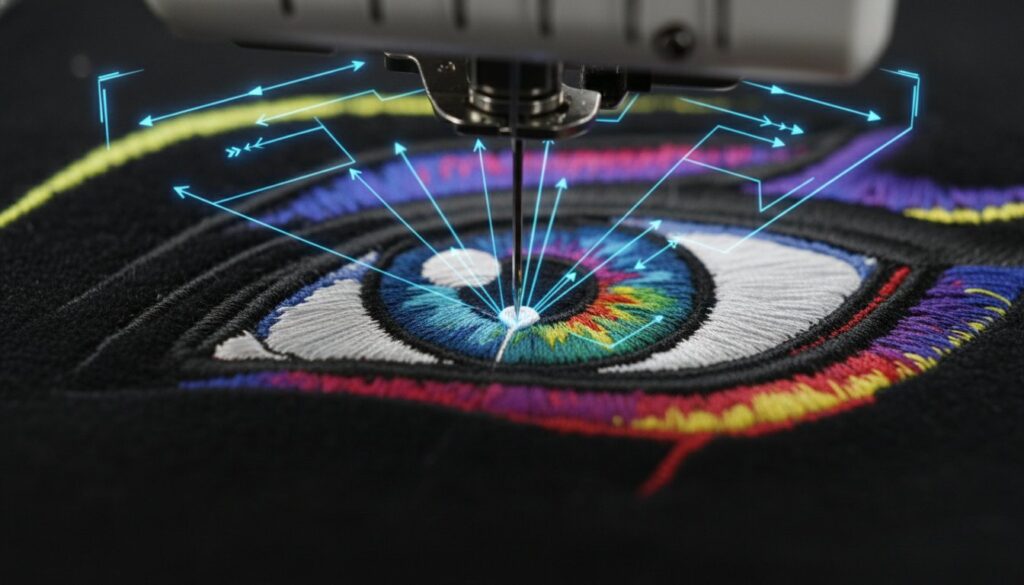
In the high-stakes world of licensed apparel, a single misplaced stitch in a character’s eye is more than a technical error; it’s a total loss of brand identity. You’ve likely experienced the frustration of seeing a vibrant digital illustration transform into a stiff, “bulletproof” design that feels more like armor than clothing. It’s a common challenge to manage the delicate balance between bold outlines and complex color fills without facing registration gaps or distorted features. This is where professional anime digitizing moves beyond basic software automation to become a true technical craft.
We understand that maintaining character integrity is your top priority. This guide demonstrates how manual pathing logic preserves the fine details of your artwork while ensuring every design is production-ready and scalable. You’ll discover how to achieve crisp, clean outlines that align perfectly every time. We’ll also break down the specific methodologies used to create efficient stitch paths, reducing your machine time and increasing your overall output. By focusing on precision engineering at the stitch level, you can deliver high-quality results that meet the demands of a growing global market.
Key Takeaways
- Learn how to manage high-contrast cell shading to ensure perfect color registration without gaps.
- Master the technical precision required in anime digitizing to preserve character expressions and fine facial details.
- Discover the advantages of manual pathing over automated software to eliminate “bulletproof” designs and excessive thread trims.
- Identify strategies to optimize complex files for high-volume production, reducing needle breaks and machine downtime.
- Explore how a professional workflow delivers scalable, production-ready designs with a reliable 12-hour turnaround.
Why Anime Artwork Challenges Standard Embroidery Digitizing
Standard logo digitizing often relies on simple shapes and uniform fills. In contrast, anime digitizing is a specialized technical discipline that must account for high-contrast, line-heavy Japanese-style art. This artwork isn’t just a collection of shapes; it’s a complex arrangement of specific artistic conventions that don’t always translate easily into thread. To successfully convert these designs, a digitizer must understand the nuances of the computerized embroidery process and how digital vectors behave when pushed through a high-speed industrial machine.
The primary hurdle is the “Cell Shading” technique common in anime. This style uses distinct, flat color blocks to create depth and shadow. In an embroidery context, these blocks must be perfectly registered against one another. If a single block of color shifts by even a fraction of a millimeter, the entire character’s anatomy can look distorted. Unlike traditional gradients where colors blend, anime art demands sharp, clean edges that meet exactly at the boundary of a bold outline. This leaves zero room for error in pull compensation or pathing logic.
Detail density presents another significant challenge. Anime characters often feature intricate details in very small areas, particularly within the pupils of the eyes. Attempting to pack multiple layers of thread into a 5mm space often leads to thread nesting or needle breaks. A professional approach involves managing the stitch order so that highlights and fine details sit correctly without creating “bulletproof” sections that are too thick for the fabric to support. Additionally, characters require variable stitch directions. To make hair look natural or fabric appear to flow, the digitizer must manually set the angles of every stitch block, a task that requires a high degree of craftsmanship.
The Complexity of Bold Outlines vs. Fine Detail
A typical anime character features a heavy satin stitch border paired with razor-thin internal facial lines. Balancing these is difficult. Thick borders exert significant pull on the fabric, which can easily swallow up those fine internal lines if the density isn’t calibrated correctly. Automated software often fails here because it can’t distinguish between a structural character outline and a subtle shadow. In 2026 production environments, where speed is essential, precise density management is the only way to prevent fabric puckering on lightweight garments like modern t-shirts.
Registration Challenges in Multi-Layered Designs
The “Gap” problem is the most common failure in low-quality anime embroidery. It happens when color fills and outlines separate during the stitch-out process, leaving visible fabric between them. Because anime art relies on flat colors, these gaps are immediately obvious. Solving this requires expert knowledge of how different fabrics, from heavy denim to stretchy performance wear, react to stitch tension. Perfect edge-to-edge alignment is achieved through manual pathing that anticipates fabric movement before the first stitch is even laid down.
Mastering the Anime Eye: Technical Precision in Stitch Pathing
The eyes are the undisputed focal point of any character design. In the context of anime digitizing, technical precision in this small area dictates the success of the entire garment. A shift of just 0.5mm in the pupil or highlight can transform a determined gaze into a look of confusion. Achieving this level of accuracy requires more than just high-end software; it demands a deep understanding of stitch pathing logic and how thread behaves at a micro-scale.
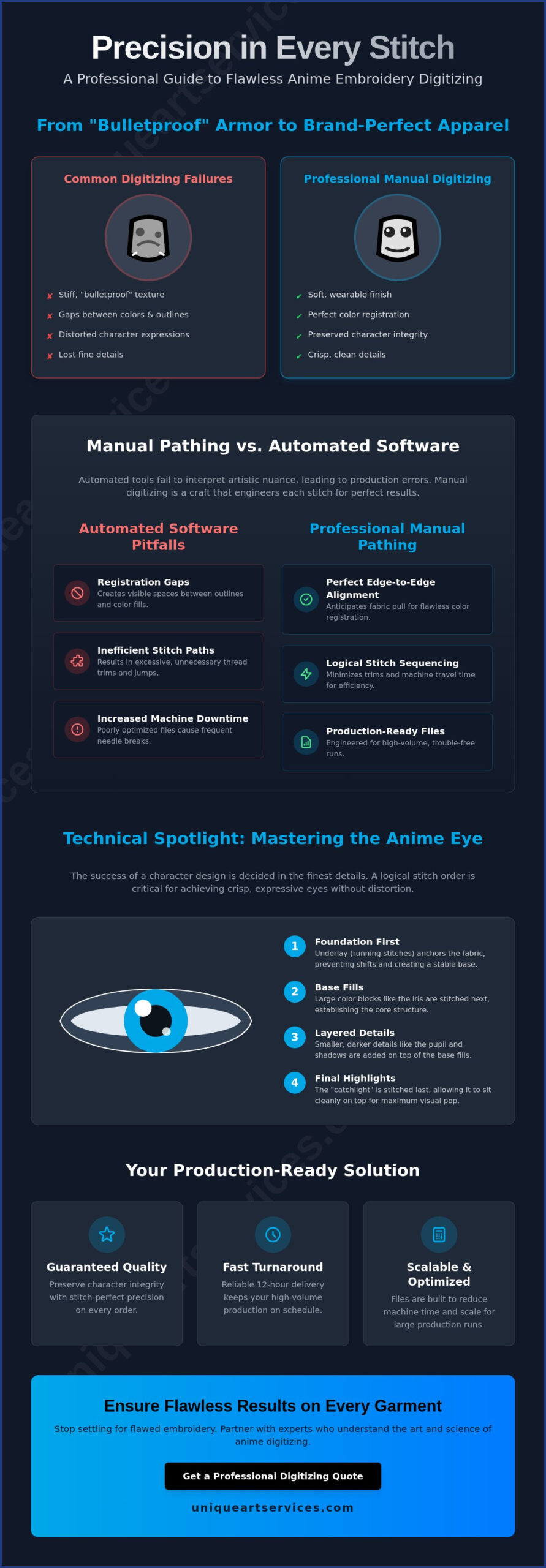
Professional pathing ensures that the smallest details, such as the “catchlight” highlights, are programmed to stitch last. This allows them to sit cleanly on top of the base fill rather than getting buried. To ensure a smooth embroidery production process, we use strategic “Running Stitches” beneath satin columns. This technique anchors the fabric and provides a stable foundation, preventing dense stitches from shifting. By optimizing start and end points within the eye area, we also minimize the risk of “bird-nesting.” These tangled thread clusters often occur when a machine struggles with high-density details, but they’re easily avoided with a logical pathing sequence. If you’re encountering issues with distorted expressions during stitch-out, consulting with professional digitizing support can help streamline your workflow.
Pull Compensation and Facial Symmetry
Calculating “pull” is essential for maintaining facial symmetry, especially on stretchy knits or performance fabrics. Manual digitizers add specific “extra” width to satin stitches to compensate for the natural tension of the thread. Without this adjustment, perfectly circular eyes in your digital art will appear as squashed ovals on the finished product. We ensure consistent stitch angles across both eyes. This prevents light from reflecting differently off the thread, which would otherwise create an unsettling, asymmetrical appearance on the character’s face.
Layering Highlights and Pupils
The technical sequence is vital for creating visual depth. We follow a strict order: underlay, base fill, iris detail, and finally the highlight. For the iris, we often utilize specialty stitches like tatami with custom offsets to create a textured, multi-dimensional look. This layering must be achieved with a minimum number of trims. Excessive trimming slows down your machines and leaves a messy, abrasive back-side on the garment. Efficient anime digitizing balances these aesthetic layers with the practical needs of high-speed industrial embroidery.
Manual Digitizing vs. Automated Software for Complex Characters
The temptation to use “Auto-Digitize” buttons is high, especially with the advancements in modern embroidery software. However, automated algorithms remain fundamentally incapable of handling the artistic nuance required for anime digitizing. Software sees shapes and colors as mathematical data points, whereas a professional digitizer sees a character with specific expressions and physical flow. This human interpretation is the difference between a design that runs smoothly and one that causes constant machine errors. Understanding the common vector tracing errors that automated software introduces is essential for any brand serious about production quality.
Automated software often creates what the industry calls “bulletproof” designs. These files are characterized by excessive, unnecessary stitches layered on top of one another. The result is a stiff, heavy patch of thread that feels like armor and can cause the garment to pucker or even tear. At Unique Art Services LLP, our manual intervention ensures that every stitch serves a purpose. We interpret the artwork to decide where to simplify details for better production and where to emphasize them for visual impact. This meticulous approach is the reason Unique Art Services LLP maintains a 99% first-time-right rate for our clients.
Stitch Logic and Pathing Efficiency
Manual pathing allows for the implementation of “Smart Trims.” In a high-volume commercial environment, every thread trim adds seconds to the production cycle. Over a run of several hundred garments, these seconds accumulate into hours of wasted machine downtime. We utilize the “Travel Stitch” technique, where the needle moves between different sections of the design invisibly, tucked under future layers of thread. This eliminates the need for a trim and a restart. Manual digitizing is the intentional placement of every needle penetration for optimal flow.
Interpreting Vector Art for Embroidery
While a clean vector art file is a necessary starting point, it’s only the first step in a technical workflow. Vectors have infinitely sharp corners that the physical world of thread cannot replicate without intervention. We manually convert these sharp vector intersections into “Mitered” or “Lapped” satin joins. These specialized joins prevent thread from piling up in a single spot, which would otherwise lead to needle breaks or thread shredding. If your source material is a low-resolution raster, converting a low resolution image to vector first ensures we have the high-resolution foundation required for this level of precision. By bridging the gap between digital art and physical production, we ensure your characters look as good on fabric as they do on screen.
Optimising Anime Designs for High-Volume Apparel Production
High-volume apparel production demands a shift from purely artistic reproduction to operational efficiency. When you’re running thousands of units, a design that looks good but stitches poorly becomes a liability. Professional anime digitizing must balance aesthetic detail with machine speed and thread durability. If a file isn’t optimized, you’ll face constant thread shredding or needle breaks on industrial machines. These interruptions don’t just slow down your team; they eat into your profit margins and risk damaging the garments themselves.
To avoid “Stitch Heavy” areas, we identify where density can be reduced without losing visual impact. This is particularly important in overlapping color blocks common in cell-shaded art. Universal compatibility is also a non-negotiable requirement for global production. Standardizing files as DST embroidery files ensures that your designs run flawlessly across different machine brands without translation errors. We also ensure every design is “Hooping-Friendly.” By centralizing start and stop points, we make it easier for machine operators to align the design correctly, reducing the likelihood of misaligned prints across a production run.
Reducing Machine Downtime
The cost of a trim is a real factor in production planning. Every time a machine stops to trim a thread, you lose approximately 10 to 15 seconds. In a design with 20 unnecessary trims, that’s over three minutes of lost time per garment. Our manual pathing eliminates these gaps, keeping the needles moving. This efficiency is why global brands rely on us. If you’re preparing for a major product drop, the 4-hour rush processing at Unique Art Services LLP ensures your files are production-ready, supporting even the tightest launch windows.
Density Management for Different Fabrics
One size never fits all in the world of embroidery. A design digitized for a heavy fleece hoodie will fail if applied to a light jersey t-shirt. The heavy stitch count required to penetrate fleece will cause a t-shirt to pucker and drape poorly. We adjust the anime digitizing parameters based on your specific garment choice. This includes the strategic use of underlay stitches, which stabilize the fabric and provide a smooth surface for the top fills. Proper underlay allows for lower top-stitch density, which keeps the design flexible and prevents that “cardboard” feel on lighter fabrics. If you’re ready to optimize your next collection, professional digitizing support can help refine your technical specs.
Scalable Anime Digitizing Solutions with Unique Art Services LLP
Scaling an anime-focused apparel brand requires more than just high-quality art; it requires a technical infrastructure capable of handling volume without compromising character integrity. Unique Art Services LLP provides this backbone for global brands, leveraging over 15 years of industry experience to manage high-capacity design fulfillment. Our specialized workflow is designed to eliminate the friction points common in complex character work, such as registration gaps and excessive stitch counts. By providing anime digitizing that respects the “Artist’s Intent,” we ensure your characters translate perfectly from screen to stitch every time.
Our global service hubs provide round-the-clock support for clients in the UK, US, and Australian markets. This ensures that technical assistance is available regardless of your time zone, keeping your production schedule on track. The Unique Art Services LLP process involves a rigorous three-step system: initial artwork analysis, expert manual digitizing, and a final quality check before delivery. This commitment to precision is what allows us to deliver production-ready files in a standard 12-hour window while maintaining the highest standards of embroidery digitizing in the industry.
The 4-Hour Rush Order Advantage
In the competitive world of limited-edition drops, speed is often the deciding factor in a campaign’s success. We’ve developed a robust system to meet even the most aggressive apparel launch windows with our 4-hour rush processing. Despite the rapid turnaround, we maintain a 99% first-time-right accuracy rate. This efficiency prevents the costly cycle of wasted samples and machine downtime that often plagues brands using less experienced services. Our “First-Time-Right” philosophy ensures that your project moves directly from digitizing to the production floor without delays.
Custom Partnerships for Apparel Brands
We aim to be more than a service provider; we position ourselves as a technical partner in your supply chain. This means providing ongoing consultation on how to best adapt complex anime aesthetics for evolving garment trends. Understanding the criteria for choosing the best embroidery digitizer is essential for long-term brand stability. By integrating our expertise into your workflow, you gain the freedom to push the boundaries of character design while knowing the technical execution is in expert hands. Contact Unique Art Services for a quote on your anime project to begin scaling your production today.
Elevate Your Anime Apparel Production
Anime artwork demands a level of technical precision that standard digitizing simply cannot provide. By mastering complex pathing and manual density management, you ensure your characters maintain their soul on every garment. We’ve explored how professional anime digitizing removes the friction from high-volume production, replacing “bulletproof” designs with efficient, machine-friendly files that protect your profit margins. Success in this category depends on the bridge between digital art and physical thread.
Unique Art Services brings over 15 years of industry experience to every project. We maintain a 99% first-time-right accuracy rate, ensuring your product launches stay on track without the need for endless sampling. Whether you require our standard 12-hour turnaround or a 4-hour rush for an urgent streetwear drop, our team provides the stability your brand needs to scale. Stop struggling with distorted facial features and costly thread breaks. Get Your Anime Artwork Digitized in 12 Hours and experience the precision of expert manual pathing. Your creative vision deserves execution that performs flawlessly on the production floor.
Frequently Asked Questions
What is the best stitch type for anime hair?
Satin stitches are the ideal choice for defining the sharp, tapered locks typical of anime hair styles. For larger sections, we utilize tatami fills with manually adjusted stitch angles to mimic the direction of hair flow. This combination ensures that the hair looks dynamic and maintains its intended shape without looking flat or unnatural during the stitch-out process.
How do I prevent gaps in my anime embroidery outlines?
You prevent gaps by applying precise pull compensation and ensuring your fill stitches slightly overlap with the border outlines. This technical adjustment accounts for the fabric being pulled inward by thread tension. Professional anime digitizing involves pre-calculating this movement based on your specific fabric type to maintain perfect registration and edge-to-edge alignment.
Can you digitize highly detailed anime characters for small left-chest placements?
We can digitize complex characters for small placements, but it requires strategic simplification of the artwork. Our digitizers identify which fine lines can be merged or removed to prevent thread nesting while preserving the character’s core likeness. This ensures the design remains clean and recognizable even when scaled down to a standard 3.5-inch left-chest area.
Why does my anime design feel stiff and heavy on the shirt?
Stiff designs usually result from excessive stitch density or unnecessary layering of thread. When a design has too many “bulletproof” layers, it loses flexibility and becomes uncomfortable for the wearer. We solve this through manual pathing that reduces the total stitch count and eliminates redundant layers without compromising the visual depth of the character.
How long does it take to get a custom anime design digitized?
Our standard delivery time for a custom design is 12 hours. For apparel brands facing tight production windows or limited-edition drops, we offer a 4-hour rush processing service. This rapid turnaround ensures you can move from a digital art concept to a production-ready embroidery file within a single business day.
What file format do I need for my commercial embroidery machine?
DST is the most common file format used by commercial embroidery machines worldwide. It’s a universal standard that carries all necessary stitch data and machine commands for industrial equipment. We provide files in DST and other common formats like PES, JEF, or EXP to ensure total compatibility with your specific machine brand.
Is manual digitizing really better than using auto-digitizing software for anime?
Manual digitizing is significantly superior because it allows for human interpretation of artistic nuance. Automated software cannot make logical decisions about pathing, trim placement, or facial symmetry. Expert manual intervention is the only way to achieve anime digitizing that runs efficiently on high-speed industrial machines while maintaining the character’s original integrity. Brands that rely on automation frequently encounter common vector tracing errors that compromise production-ready files and require costly rework.
How do I ensure the eyes in my anime design look sharp?
To ensure eyes look sharp, the highlights must be programmed to stitch last so they sit cleanly on top of the iris fills. We also utilize a stable running stitch foundation under the eye area to prevent the fabric from shifting. This specific pathing sequence preserves the character’s expression and ensures every fine detail remains crisp on the finished garment.