Choosing the Best Embroidery Digitizer in 2026: Software vs. Professional Services
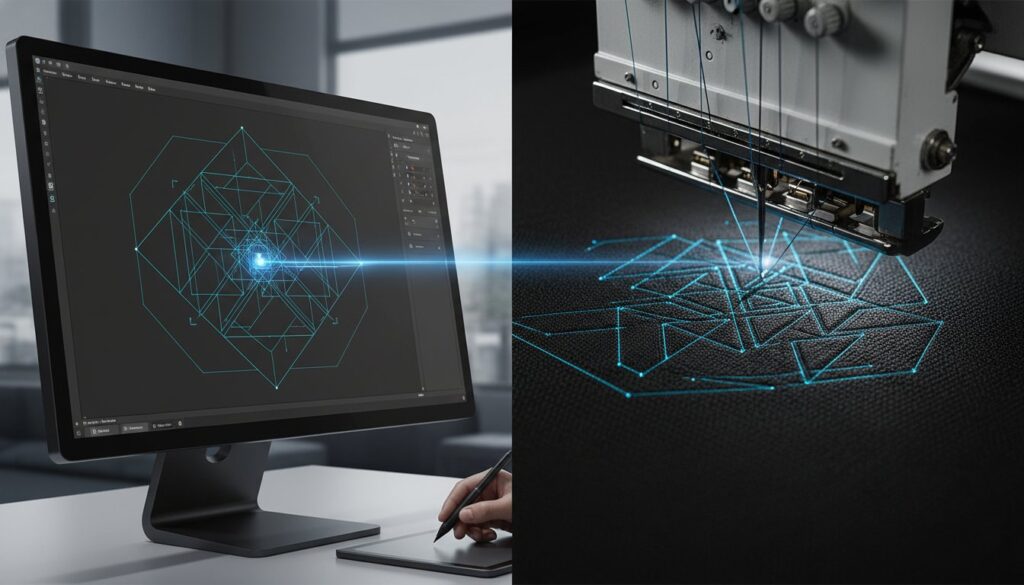
Your high-speed embroidery machine is only as efficient as the file you feed it. Choosing the right embroidery digitizer isn’t just a software purchase; it’s a critical business decision that defines the technical bridge between your artwork and a flawless finished product. If you’ve ever struggled with bird-nesting or constant thread breaks, you know that a poor file can turn a profitable afternoon into a production nightmare.
We understand that wasted machine time is lost revenue. You want production-ready files that run smoothly the first time, every time. This guide explores the most efficient ways to convert your designs into stitches by comparing the latest 2026 software capabilities with the scalability of professional digitizing services. We’ll break down the total cost of ownership, turnaround speeds, and how to maintain high-quality output without the steep learning curve of complex licenses. Whether you’re looking to manage a few custom pieces or scale your entire production capacity, we’ll help you find the most reliable path to professional results.
Key Takeaways
- Learn to distinguish between digitizing software and the human expertise required to map complex stitch paths for production-ready files.
- Evaluate the 2026 software landscape to determine if a high-cost license or a flexible professional service fits your current production volume.
- Discover why manual pathing remains superior to automated tools for maintaining design integrity on challenging fabrics like performance wear or headwear.
- Identify the critical criteria for selecting an embroidery digitizer, including turnaround speed, technical support, and pricing transparency.
- Explore how a global digitizing partner can provide 12-hour standard delivery and 4-hour rush processing to help you meet demanding client deadlines.
What is an Embroidery Digitizer? Understanding the Two Paths
An embroidery digitizer serves a dual role in the modern production environment. The term describes both the technical software used to build stitch files and the professional technician who executes the design. In a commercial setting, when a shop manager mentions their digitizer, they’re almost always referring to the specialist responsible for mapping out the design’s DNA. This includes critical decisions on stitch direction, density, and the structural underlay that prevents fabric puckering.
The craft has evolved significantly from the era of manual punch cards and paper tapes. Today, the process relies on computerized machine embroidery systems that translate vector artwork into complex coordinate data. While the technology has advanced, the core objective remains the same: transforming a static image into a dynamic path that a high-speed needle can follow without interruption.
The Software vs. The Specialist
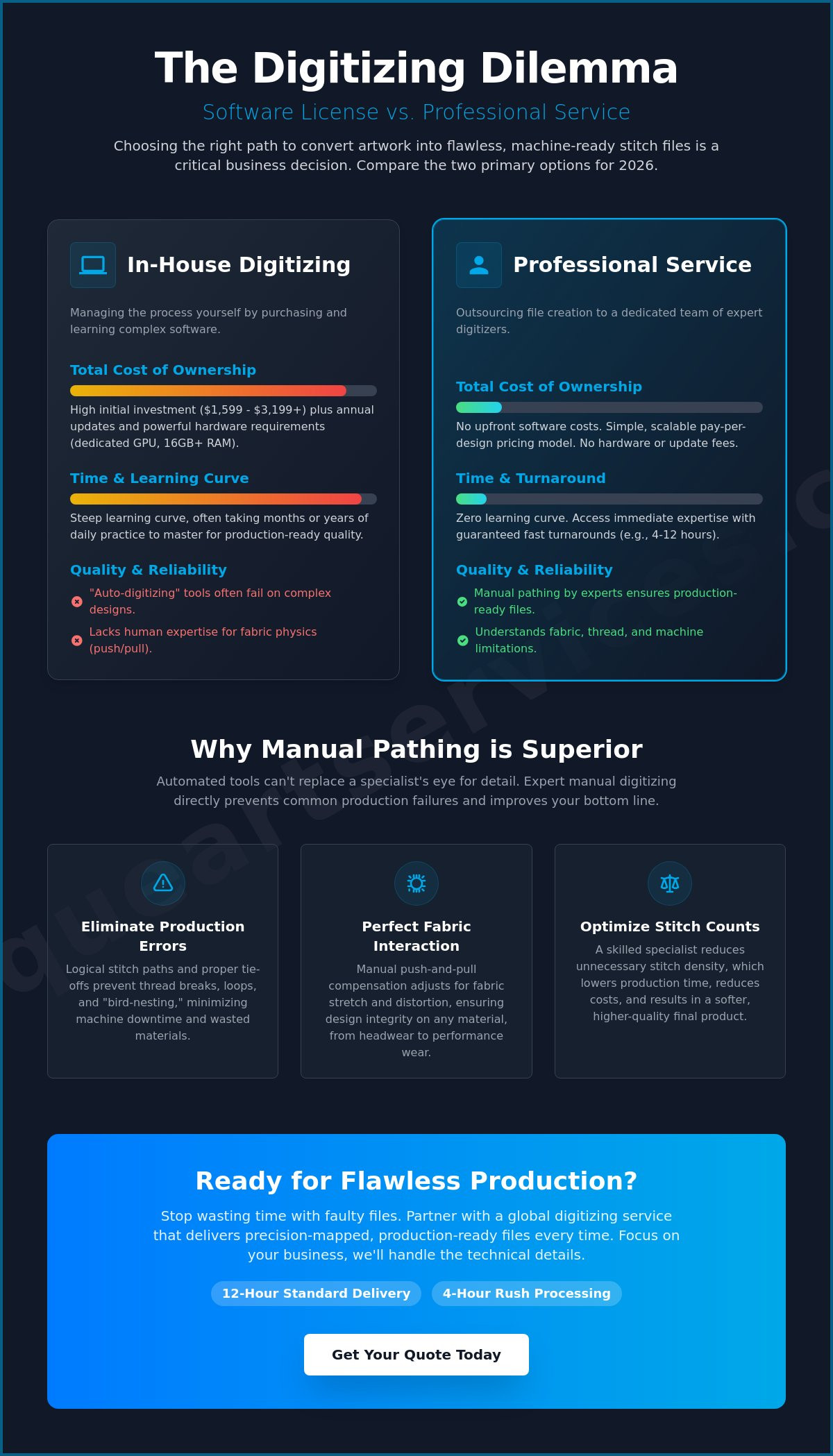
Modern software suites are powerful tools, but they require a heavy investment of both capital and time. Learning to use professional-grade software effectively can take months or even years of daily practice. Even the most expensive programs can’t replace the human eye. A software-only approach often misses the nuance of fabric physics. Every material, from delicate silk to heavy denim, reacts differently to needle penetration.
A professional specialist understands push-and-pull compensation. They manually adjust the design to account for how the fabric will stretch or shift during production. Software alone cannot guarantee a production-ready file because it lacks the real-world experience of how different thread tensions and stabilizers interact. Relying solely on “auto-digitizing” features frequently results in files that look good on a screen but fail on the machine.
Why Technical Pathing Matters in 2026
Efficiency is the heartbeat of a profitable embroidery business. Poor pathing is the primary culprit behind needle breaks, thread loops, and excessive machine downtime. If a design isn’t pathed logically, the machine head must travel unnecessarily across the garment, increasing the risk of “bird-nesting” and mechanical wear. Every extra minute a machine spends on an inefficient design is a minute of lost profit.
Technical pathing also directly impacts your bottom line by optimizing stitch counts. A skilled specialist reduces unnecessary density while maintaining visual impact, ensuring the design remains soft to the touch and quick to sew. Manual pathing is the essential factor for clean embroidery. By prioritizing logical sequences and proper tie-offs, you ensure your equipment runs at peak performance without the friction of constant manual interventions.
Top Embroidery Digitizing Software: A 2026 Roundup
The 2026 software market is split between high-end commercial suites and accessible AI-driven tools. A professional embroidery digitizer workstation now requires robust hardware, specifically a dedicated GPU and at least 16GB of RAM, to handle real-time 3D stitch rendering and complex simulations. While AI-assisted auto-digitizing has improved significantly, it still functions best on high-contrast, simple shapes. Complex logos still require manual intervention to ensure various embroidery file formats translate correctly from vector art into machine-readable commands.
Deciding between a software license and a service provider often comes down to your production volume. A full commercial license is a significant asset, but it carries a high total cost of ownership. Beyond the initial purchase, you must account for annual updates and the hundreds of labor hours required to master the interface. For many growing brands, the most efficient route is to focus on creative design while leaving the technical file creation to a dedicated specialist.
Commercial Leaders: Wilcom and Hatch
Wilcom EmbroideryStudio 2026 remains the industry standard for high-volume commercial operations. The “Decorating & Digitizing” version is currently priced at $1,599.20, while the full professional suite reaches $3,199.20. These platforms excel at “branching,” a feature that automatically sequences objects to minimize jump stitches. Hatch Embroidery offers a streamlined experience for small business owners, providing best-in-class lettering and auto-fabric settings that automatically adjust density for different textiles.
Open Source and Entry-Level Options
For shops on a strict budget, Ink/Stitch provides a powerful open-source alternative built on the Inkscape vector platform. It’s free to use but demands a steep learning curve and manual pathing for every element. Embird 2026 offers a modular middle ground with a base price of $183.27. This allows users to buy only the specific plugins they need, such as Sfumato for photo-stitch designs. While these tools reduce upfront costs, the time spent troubleshooting files can quickly exceed the expense of a professional service. If the learning curve feels too steep for your production schedule, you can outsource your designs to maintain a faster, more predictable workflow.
Ultimately, software is a tool, not a solution. Even the most advanced 2026 suites require a knowledgeable operator to navigate the physics of thread and fabric. If you aren’t prepared to dedicate a staff member to full-time digitizing, the software may end up as an underutilized and expensive line item on your balance sheet.
Professional Digitizing Services: Why Manual Expertise Wins
While high-end software provides the necessary toolbox, a professional embroidery digitizer provides the craftsmanship required to navigate real-world production challenges. Auto-digitizing functions often create a “paint-by-numbers” effect that ignores the mechanical physics of thread pull. This leads to excessive stitch counts and poor transitions that slow down your machines. Professional services focus on a “first-time-right” philosophy. They ensure the file you receive is ready for the hoop without requiring multiple test sew-outs or manual adjustments on the shop floor.
Garment-specific optimization is where manual expertise truly shines. A design intended for a structured six-panel hat requires a “center-out” pathing logic to prevent the fabric from shifting and causing registration errors. Conversely, a logo for a heavy fleece hoodie needs specialized underlay to prevent the stitches from sinking into the pile. The history of embroidery shows a transition from hand-stitched artistry to high-speed industrial output, yet the need for human oversight remains constant. This specialized embroidery digitizing ensures every needle penetration is purposeful and efficient.
Manual Pathing vs. Auto-Tracing
Auto-tracing tools struggle with fine details and small text. They often interpret shadows as separate stitch layers, creating unnecessary bulk and thread breaks. Manual pathing involves redrawing the design to establish a logical sequence that minimizes jump threads and trims. This is particularly vital for intricate corporate logos where clarity is paramount. The same challenge applies to highly detailed character artwork; professional anime digitizing relies on this same manual pathing discipline to preserve fine facial features and color transitions that auto-tracing consistently distorts. To achieve the best results, many shops start by converting pictures to vector format before the digitizing process begins. This creates a clean, high-resolution foundation that allows the digitizer to map every satin stitch and fill with absolute precision.
Clients who regularly supply pixelated or low-quality artwork face an additional upstream challenge. Understanding how to handle a low resolution image to vector conversion is a critical first step before any digitizing work can begin, ensuring the source file is clean enough to produce accurate stitch paths.
Quality Control in Professional Hubs
Professional digitizing firms use a multi-stage review process that software alone can’t replicate. Each file undergoes a technical audit to verify density and pull compensation before it reaches your inbox. This includes testing the design against various embroidery file types to ensure total compatibility with your equipment. Whether you run Tajima, Barudan, or Brother machines, a professional service guarantees the file is optimized for your specific hardware’s tension and speed requirements. This rigorous quality control eliminates the guesswork and allows you to commit to tight client deadlines with total confidence.
How to Choose the Best Embroidery Digitizer for Your Brand
Selecting the right embroidery digitizer requires a shift in perspective. You shouldn’t just look for the lowest price. Focus on production efficiency and stitch count optimization. A file with 2,000 unnecessary stitches adds minutes to every run. Over a 500-piece order, those minutes turn into hours of lost machine time and wasted thread.
Most professional hubs use two primary models for billing. Flat-rate fees provide budget predictability for standard left-chest logos, often ranging between $15 and $30 in the current 2026 market. Per-thousand-stitch pricing is the standard for larger, complex designs like jacket backs. Evaluate your monthly volume to see which model scales best with your business. When your schedule is tight, you can get production-ready files that meet these rigorous standards without sacrificing quality.
Assessing Turnaround and Reliability
Reliability is measured in hours, not days. A standard 12-hour window is the industry benchmark for professional services. However, seasonal peaks or last-minute client changes often require 4-hour emergency rush processing. Your chosen partner must offer 24/7 global support to handle these time-sensitive projects across different time zones. Scalability is equally important. Ensure your provider can handle 50 logos a day during your busiest months without a dip in technical accuracy.
Technical Compatibility and File Standards
Your digitizer should deliver files that are ready for immediate use. This means providing the correct DST, PES, or EMB formats tailored to your specific machine brand. Every delivery should include a PDF production sheet. The document must detail color stops, thread sequences, and estimated stitch counts. Professional firms aim for a 99% first-time-right rate. High accuracy ensures that your machines keep running instead of sitting idle while you wait for file revisions.
Unique Art Services LLP: Your Global Partner in Precision Digitizing
Efficiency in 2026 requires more than just high-end software; it demands a partner who acts as a seamless extension of your production floor. Unique Art Services LLP bridges the gap between creative vision and machine performance by leveraging over 15 years of experience in manual embroidery digitizing. We understand that a file is only as good as its performance on the machine. By focusing on technical precision and manual pathing, we help you eliminate the common frustrations of thread breaks and wasted materials.
Our commitment to speed is built into our operational DNA. We offer a 12-hour standard turnaround to keep your daily production on track. When deadlines are critical, our 4-hour rush processing provides an emergency lifeline to ensure you never miss a client delivery. This reliability is backed by a 99% accuracy rate. By delivering production-ready files that run smoothly the first time, we significantly reduce your machine downtime and operational waste. We don’t just provide a file; we provide a stable foundation for your business growth.
The Unique Art Services LLP Workflow
Our methodology is designed for transparency and predictability. Every project follows a rigorous three-step process to ensure technical excellence.
- Step 1: Technical Analysis: We begin with a deep dive into your artwork, assessing stitch complexity and the specific requirements of your target garment.
- Step 2: Manual Digitizing: Our industry-leading specialists manually path every design. We avoid the pitfalls of auto-tracing to ensure clean lines and optimal stitch density.
- Step 3: Quality Check: Every file undergoes a final audit to verify compatibility and performance before delivery.
Scaling Your Production Capacity
We serve as a dedicated design hub for commercial embroidery shops across the US, UK, and Australia. This global reach allows us to handle significant volume without sacrificing the fine details that define premium craftsmanship. Whether you need to process five logos or fifty, our infrastructure scales with your demand. Our flat-rate pricing model makes budgeting simple and predictable, removing the financial uncertainty often associated with complex designs.
Beyond our core embroidery digitizer services, we offer seamless integration for vector art and logo design. This multi-platform approach ensures your branding remains consistent across all media. Join the thousands of brands that trust our precision to act as the backbone of their creative enterprises. We provide the technical expertise you need to focus on what you do best: growing your business and delivering exceptional products to your customers.
Master Your Embroidery Production Standards
Success in 2026 requires a strategic balance between modern technology and seasoned craftsmanship. While software provides the tools, the technical precision of a professional embroidery digitizer ensures your machines run at peak profitability without the friction of constant thread breaks. You’ve seen how manual pathing optimizes stitch counts and preserves design integrity across various garment types. Choosing the right path allows you to focus on growth while we handle the technical heavy lifting.
Unique Art Services LLP brings over 15 years of industry experience to every design we create. Our 99% first-time-right rate means your files are ready for the hoop the moment they reach your inbox. If you’re facing a tight deadline, our 4-hour rush order availability provides the speed you need to stay ahead. Get Your Production-Ready Design in 12 Hours or Less and experience a smoother, more efficient workflow today. Let’s transform your creative vision into flawless machine performance.
Frequently Asked Questions
What is the difference between an embroidery digitizer and a graphic designer?
A graphic designer creates visual art for print or digital screens using pixels and vectors. An embroidery digitizer translates that artwork into technical machine code. While a designer focuses on aesthetics, a digitizer focuses on the physics of thread, mapping out stitch types, densities, and pull compensation to ensure the design sews correctly on fabric.
How much does it cost to have a logo digitized for embroidery?
Industry pricing in 2026 typically follows two primary structures. Small designs under five inches usually incur a flat rate between $15 and $30. Larger projects, such as full jacket backs, often use a per-stitch model. These larger designs generally range from $2.00 to $4.00 per 1,000 stitches depending on the complexity of the artwork.
Can I use auto-digitizing software for professional production?
Auto-digitizing software is rarely sufficient for high-volume commercial production. These automated tools often create excessive stitch counts and illogical paths that lead to frequent thread breaks. Professional results require manual pathing to account for the “push and pull” of specific textiles, a nuance that AI-driven tools still struggle to master perfectly.
What file format do I need for my embroidery machine?
The required format depends entirely on your machine brand. Tajima and many commercial machines use DST files. Brother machines typically require PES, while Janome uses JEF and Bernina uses EXP. Always verify your equipment’s technical requirements before ordering to ensure the file is compatible with your specific hardware.
How long does it take to digitize a logo for a hat?
A professional service can usually digitize a hat logo within 12 to 24 hours. Hat designs are technically unique because they require “center-out” and “bottom-up” pathing logic. This specialized sequencing prevents the fabric from shifting on the curved surface of the cap, ensuring the finished embroidery remains crisp and centered.
Why does my digitized file keep causing thread breaks?
Constant thread breaks are usually a symptom of poor pathing or excessive stitch density. If a design has too many stitches in a small area, the needle experiences high friction and heat. Improper tie-offs and poorly sequenced jump stitches also contribute to mechanical issues. A manually optimized file eliminates these bottlenecks by streamlining the needle’s path.
What is the best software for a beginner embroidery digitizer?
Hatch Embroidery is widely considered the best entry point for beginners in 2026. It features an intuitive interface and helpful auto-fabric settings that adjust density for the user. For those aiming for high-level commercial work, Wilcom remains the industry standard due to its comprehensive technical control and advanced sequencing capabilities.
How do I know if a digitizing service is high quality?
A high-quality service always provides a detailed PDF production sheet with every delivery. This document should include color stops, stitch counts, and a digital preview of the sew-out. Look for providers that maintain a 99% first-time-right rate and offer technical support for machine-specific troubleshooting. A strong portfolio should show clean lines and smart underlay on various fabric types.