Professional Logo Design for Merchandise: Engineering Your Brand for Physical Production
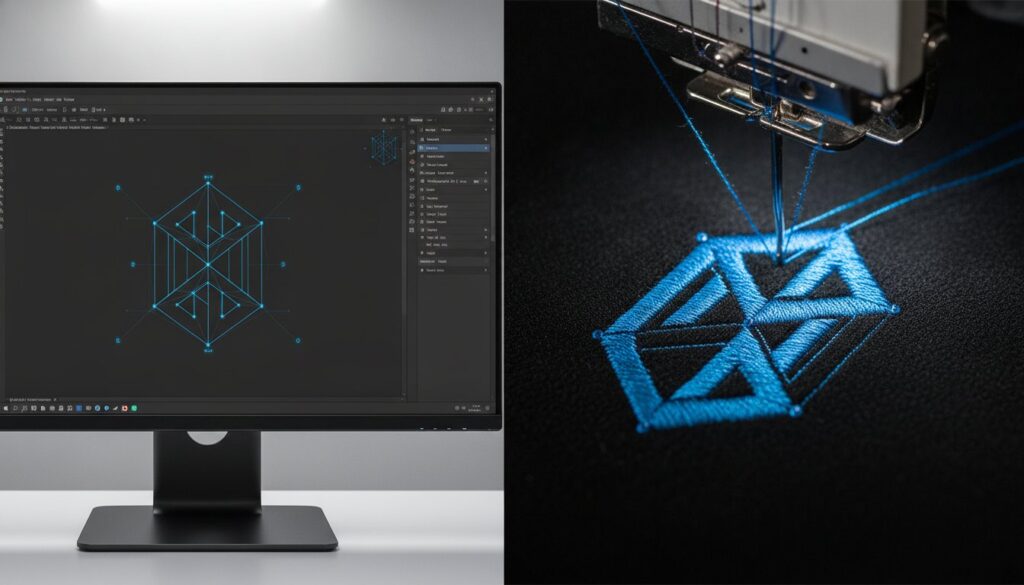
A stunning digital logo is useless if it fails the moment it hits a needle or a screen-printing press. For physical products, a logo isn’t just a graphic. It’s a technical blueprint. When logo design for merchandise isn’t engineered for production, the results are predictable: pixelated prints, messy embroidery, and costly rejections from production houses. Since 75% of consumers recognize a brand primarily by its logo, you can’t afford to let technical errors dilute your brand’s impact or professional image.
You’ve likely experienced the frustration of seeing a crisp screen design turn into a muddy mess on a promotional hat. It’s a common bottleneck that slows down your marketing and wastes your budget. This article will show you how to transition from a digital concept to production-ready artwork that ensures flawless results on any promotional item. We’ll examine the specific steps needed to create scalable, crisp designs that are first-time-right for the factory floor. You’ll learn how to secure professional-grade files that bypass production delays and move your brand into the hands of your customers with total precision.
Key Takeaways
- Define the technical engineering required for “merch-ready” artwork to prevent production rejections and quality loss.
- Learn why manual vector redrawing is superior to automated tools for maintaining crisp, scalable results on any surface.
- Evaluate the production risks of DIY tools and how professional logo design for merchandise eliminates hidden costs.
- Discover specific design constraints for different media, including minimum line weights for embroidery and large-scale print rules.
- Streamline your workflow with expert digitizing and vector services that deliver production-ready files with high-speed fulfillment.
The Critical Difference: Why Standard Logos Fail on Physical Merchandise
Designing for a screen is easy. Designing for a factory is an engineering challenge. Most businesses treat their brand identity as a static image. However, effective logo design for merchandise requires a shift in perspective. A “merch-ready” design isn’t just a high-resolution file. It’s artwork specifically engineered to respect the physical constraints of manufacturing. When you skip this technical step, you risk muddy prints and distorted embroidery.
While digital displays render millions of colors and microscopic details, physical production operates on different rules. A high-resolution JPEG might look perfect on a 4K monitor. It provides zero instructions for an embroidery machine or a screen-printing press. These machines don’t see pixels; they see paths, stitch counts, and ink layers. If your artwork doesn’t account for these variables, the transition from screen to product will fail. The gap between digital pixels and physical stitches is where most branding projects lose their quality.
Understanding the history and principles of logo design shows that versatility has always been key. Modern digital tools often encourage complex effects that don’t translate to physical objects. Adopting a “production-first” mindset ensures your brand remains intact regardless of the medium. This approach saves time, prevents technical friction with vendors, and protects your marketing budget from avoidable errors.
The Limitations of Digital-Only Logos
Digital-first logos often rely on gradients, drop shadows, and glow effects. These look great on a website, but they’re a nightmare for embroidery. Thread cannot blend like pixels. It requires distinct blocks of color. Similarly, the fine lines that look elegant on a business card often disappear or “bleed” when printed on small promotional items like pens. When a design isn’t optimized, production houses will reject the proof. This forces you back to the drawing board and delays your marketing campaign.
The ROI of Production-Ready Artwork
Investing in technically sound files pays dividends. Clean, production-ready artwork reduces setup fees at print shops. Technicians don’t have to spend hours fixing your files. This ensures brand consistency across diverse materials, from cotton hoodies to metal water bottles. Getting your logo design for merchandise right the first time eliminates the risk of costly reprints. It guarantees that your promotional items look as professional as your digital presence.
- Clean files reduce labor costs at the production house.
- Optimized designs prevent ink bleed on porous fabrics.
- Vector-based paths ensure sharp edges on laser-etched metal.
Technical Foundations of Artwork for Promotional Items: Vectors and Digitizing
Precision is the difference between a successful product launch and a box of wasted inventory. When executing logo design for merchandise, you must move beyond standard image files. You need a master blueprint that scales infinitely without losing clarity. This foundation begins with vector art and extends into specialized digitizing for apparel. Without these technical layers, your brand identity remains trapped in a digital format that production machines simply cannot read.
Scale dictates the success of every promotional item you produce. A design that looks perfect on a billboard might fail on a keychain if the lines are too thin or the details are too dense. High-quality production requires files that adapt to these physical realities. Whether you’re creating a one-inch lapel pin or a ten-foot banner, the underlying geometry of your artwork must be flawless to ensure a “first-time-right” result at the factory.
Vector Art: The Universal Blueprint
Vector files, specifically in .EPS and .AI formats, are the industry standard for physical production. Unlike raster images made of pixels, vectors use mathematical paths. This allows the design to scale to any size without pixelation. Clean paths and minimal anchor points are vital for vinyl cutting and laser engraving. If your file has too many “points,” the cutting blade will stutter, which creates jagged, unprofessional edges. While many try to use automated “live trace” tools, these often produce messy paths that fail in production. Professional manual redrawing ensures every curve is smooth and production-ready. Understanding the difference in Vector vs Raster for Logos is essential for anyone serious about physical branding.
Protecting your brand identity is just as important as the file format itself. As you finalize your production files, consider the legal steps for trademarking your logo to secure your intellectual property across all merchandise categories. This ensures your engineered designs remain exclusive to your business as you scale.
Embroidery Digitizing: Translating Art to Thread
Embroidery requires an entirely different technical layer. A vector file tells a printer where to put ink, but an embroidery machine needs to know exactly where to drop a needle. This process is called digitizing. It involves a technical analysis of stitch complexity, density, and machine compatibility. A custom logo design for embroidery requires specific pathing to prevent the fabric from puckering or the thread from breaking. The final output is usually a DST file, which acts as the machine’s instruction manual. Managing these technical requirements shouldn’t slow down your creative process. If you need to transform a rough sketch into a production-ready file, professional Vector Art services can bridge the gap between digital concept and physical reality.
DIY Logo Makers vs. Professional Design Fulfillment: A Production Reality Check
The promise of an “instant logo” is tempting for any business owner. DIY platforms offer speed and low entry costs, which makes them ideal for brainstorming or internal mockups. However, there is a distinct gap between a visual concept and a manufacturing blueprint. For high-capacity logo design for merchandise, technical accuracy is far more valuable than initial speed. When a file is built on a generic template, it rarely accounts for the physical realities of ink and thread.
Choosing the wrong tool creates what industry veterans call the “hidden cost of free.” You might save money upfront, but you often pay for it later in production delays and file rejection fees. Production houses have strict requirements for line weights, color separations, and pathing. Most DIY tools output flat raster files that lack the mathematical precision needed for clean manufacturing. Professional fulfillment services, by contrast, maintain a 99% first-time-right rate. This reliability ensures that your project moves from the design phase to the factory floor without a single technical hiccup.
When to Use DIY Tools
DIY tools have a specific place in your creative workflow. They’re excellent for social media posts, temporary website banners, or testing color palettes. The risk lies in using these templates for your permanent brand identity. Generic templates dilute your brand’s uniqueness and often violate the technical requirements of high-end print shops. If you’ve already created a concept in a DIY app, you will likely need specialized low resolution image to vector services to transform that concept into a scalable, production-ready asset. This step is mandatory if you want to avoid pixelated results on larger items like banners or signage.
The Case for Professional Fulfillment
Professional design fulfillment acts as the technical backbone for your promotional strategy. It handles complex artwork that automated tools simply can’t process, such as detailed corporate crests or intricate illustrative logos. Speed is still a priority; many professional services offer 12-hour design fulfillment to meet tight event deadlines. Beyond just providing a file, human-in-the-loop systems offer expert advice on stitch types for embroidery and ink limitations for screen printing. This proactive approach identifies potential failures before they become expensive mistakes. By utilizing expert designers, you ensure your logo design for merchandise is engineered for precision from the very first anchor point.
- Human designers catch technical errors that AI and templates miss.
- Professional files are optimized for specific machines and materials.
- Fast 12-hour turnaround times keep your production schedule on track.
Design Strategies for Specific Merch: From Left-Chest Embroidery to Large-Scale Print
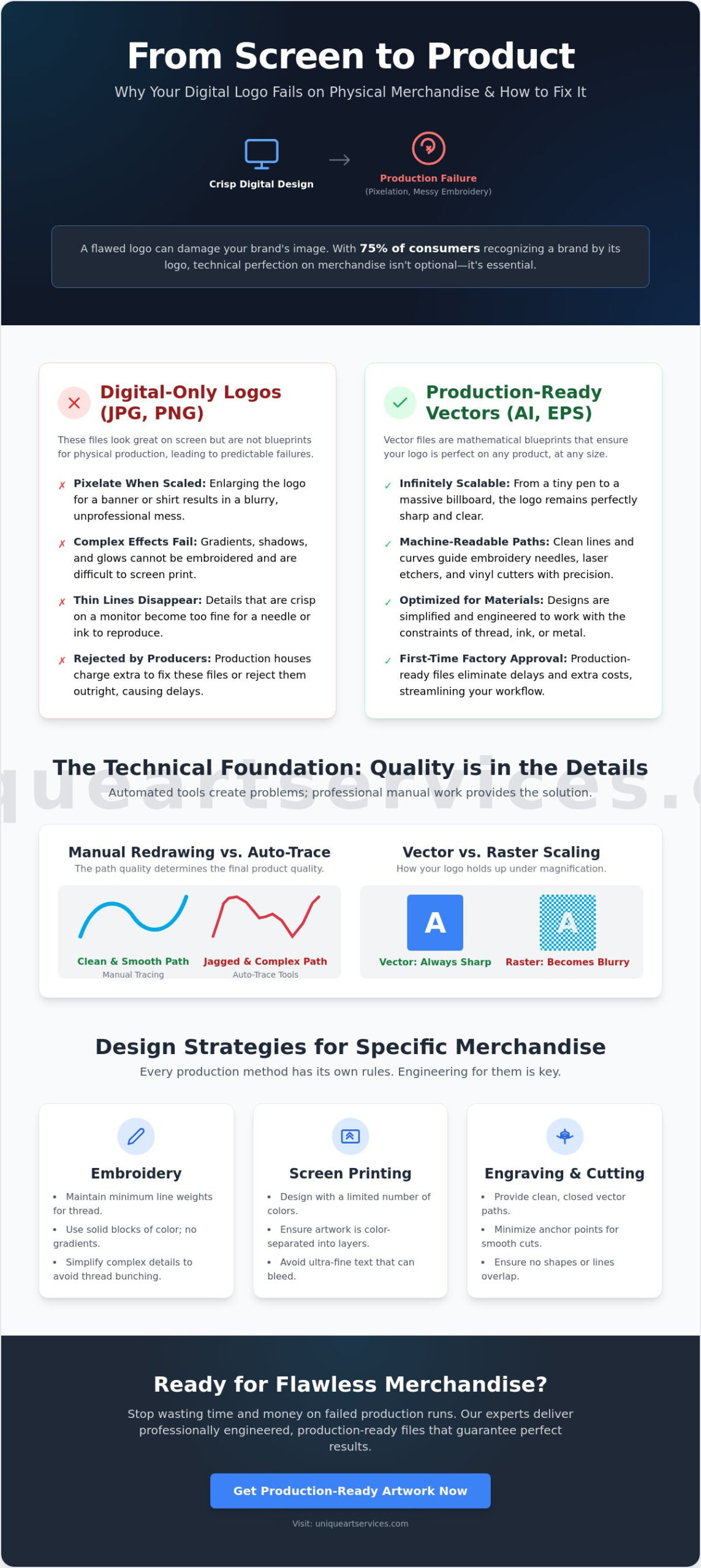
Designing for physical items requires a technical audit of every line and color. A common mistake in logo design for merchandise is applying a single file to every product type. This ignores the specific physics of the production method. For example, the “Minimum Line Weight” rule is critical for small-scale items. If a line is thinner than 0.25mm, it will likely disappear during screen printing or cause thread breaks in embroidery. When you prepare a logo for a “left chest” hit, you must often remove fine text or complex textures. This simplification ensures the brand remains legible at a smaller scale without becoming a messy knot of thread.
Consistency across different materials depends on strict color management. While digital screens use RGB, physical production relies on CMYK or the Pantone Matching System (PMS). Using PMS colors is the only way to guarantee that your brand’s specific shade of blue looks the same on a plastic pen as it does on a cotton hoodie. This precision prevents your merchandise from looking disconnected or low-quality. It also allows you to provide clear instructions to factories, which reduces the risk of expensive color-matching errors.
Optimising for Apparel (Hats, Hoodies, Tees)
Apparel presents unique challenges like the “curve” of a baseball cap. Designs for headwear must be built from the center out to prevent distortion on the embroidery frame. On thinner t-shirt fabrics, large areas of solid embroidery, known as heavy fills, can cause the material to pucker. This ruins the garment’s fit and appearance. Utilizing professional embroidery digitizing services allows you to optimize these paths for specific fabric weights. This technical step ensures that even small text remains sharp and readable against the grain of the knit.
Hard Goods and Small Promotional Items
Hard goods like pens, golf balls, and water bottles require different logic. Pad printing on small, curved surfaces requires generous spacing between elements to prevent ink bridging. For laser-engraved metal, you need high-precision vector art with closed paths. Any “open” lines in the file will cause the laser to stop or create incomplete shapes. Vinyl decals also demand clean geometry; tiny floating elements are difficult to “weed” and will likely peel off the product quickly. If you want to ensure your designs are ready for any surface, you can order professional vector conversion to secure your production quality immediately.
- Simplify logos for small embroidery areas to maintain legibility.
- Use Pantone (PMS) codes to ensure color consistency across different factories.
- Respect minimum line weights to prevent ink bleed and thread breaks.
Scaling Your Merch Production with Unique Art Services LLP
Scaling a brand requires more than just creative vision. It demands a partner that understands the high-stakes environment of physical production. Unique Art Services LLP serves as the global fulfillment backbone for businesses that cannot afford technical failure. With over 15 years of specialized experience in manual redrawing and digitizing, we bridge the gap between digital concepts and factory-ready blueprints. We operate as a proactive problem-solver; we identify potential manufacturing issues before they become expensive mistakes on the factory floor.
Deadlines in the promotional industry are often unforgiving. Our rush order processing provides 4-hour delivery for urgent projects, which gives you a significant advantage when event dates are looming. While generic platforms leave you to figure out the technical details, we provide a managed service that guarantees your logo design for merchandise is ready for any machine, fabric, or substrate. This reliability allows promotional agencies to scale their output without increasing their internal overhead or technical risk.
Our Seamless Design Workflow
Our process begins with a rigorous technical analysis of your existing artwork. We reject automated tracing tools in favor of precise manual redrawing. This ensures that every path is clean and every anchor point is mathematically necessary for the production equipment. Multi-stage quality checks are standard for every file we deliver to ensure 100% production readiness. Unique Art Services LLP operates global service hubs around the clock to provide precision logo design for merchandise on demand. This structure allows us to provide 24/7 support and consistent delivery across all international markets.
Ready to Produce? Let’s Get Started
Transitioning to a professional fulfillment model is simple and efficient. You can submit your current artwork for a comprehensive production audit to identify any technical weaknesses that might cause delays. For high-volume accounts and agencies, we offer flat-rate pricing to keep your budgeting predictable as your production needs grow. This professional approach removes the friction from your creative process. It allows you to focus on strategy while we handle the technical engineering. Get your production-ready logo design now and ensure your brand looks perfect on every item you produce.
- 15+ years of expertise in technical design fulfillment.
- 4-hour rush order processing for high-priority deadlines.
- Manual redrawing ensures 99% first-time-right production rates.
- 24/7 global support for high-volume promotional agencies.
Engineering Your Brand for Manufacturing Success
Transitioning from a digital concept to a physical product requires more than just high-resolution images. It demands technical precision that respects the physics of thread and ink. By prioritizing production-first logo design for merchandise, you eliminate the risks of pixelated prints and messy embroidery. This proactive approach protects your brand identity and your marketing budget from avoidable manufacturing errors and rejected proofs.
Professional design fulfillment ensures your files are optimized for any surface, from curved baseball caps to laser-engraved metal. With over 15 years of industry experience, Unique Art Services LLP provides a 99% first-time-right production rate that keeps your projects moving. We offer a standard 12-hour turnaround; however, 4-hour rush processing is available for your most urgent deadlines. It’s time to stop fighting with technical glitches and start producing flawless promotional items that resonate with your audience.
Upgrade your artwork for promotional items with Unique Art Services LLP and secure the technical backbone your brand deserves. Your next successful product launch is just one engineered file away.
Frequently Asked Questions
What is the best file format for logo design for merchandise?
Vector formats such as .AI, .EPS, and .PDF are the industry standard for physical production. These files use mathematical paths rather than pixels, which allows them to scale to any size without losing clarity. This precision is essential for the software that drives embroidery machines and screen-printing presses.
Can I use a JPEG for embroidery digitizing?
You cannot use a JPEG directly for embroidery. A JPEG is a raster file made of pixels, while embroidery machines require a specialized digitized file like a .DST. To create this, a technician must manually redraw the design into stitch paths that account for thread density and fabric movement.
How do I make sure my logo text is readable on small promotional items?
Ensuring readability on small items requires respecting the minimum line weight rule. Lines should be at least 0.25mm thick to prevent ink from bridging or threads from breaking. Simplification is often necessary for logo design for merchandise used on small surfaces like pens or golf balls.
What is the difference between vector art and a regular image?
Vector art is based on mathematical coordinates, while a regular image is composed of a fixed grid of pixels. When you scale a regular image, it becomes blurry or pixelated. A vector file remains perfectly sharp at any scale, whether it’s on a tiny lapel pin or a massive vinyl banner.
How long does it take to get a professional logo vectorized for merch?
Professional vectorization typically takes 12 hours for standard fulfillment. If you’re facing a tight production deadline, rush order processing can deliver production-ready files in as little as 4 hours. This speed ensures your project stays on schedule even when the factory is waiting for artwork.
Why do print shops always ask for Pantone colors?
Print shops use Pantone (PMS) colors to maintain brand consistency across different materials. Unlike standard digital colors, Pantone codes provide a universal reference that looks the same on a cotton hoodie as it does on a plastic water bottle. This prevents variations between different manufacturing vendors.
Can any logo be embroidered, or do I need a special version?
Most logos require a specialized digitized version for embroidery. This version isn’t just a different file format; it’s a set of instructions that tells the machine where to drop the needle. The digitizer must adjust the design to prevent the fabric from puckering and to ensure the thread covers the surface correctly.
What happens if my artwork isn’t production-ready?
Artwork that isn’t production-ready leads to immediate rejection from factories or expensive setup fees. You might also experience poor print quality, such as jagged edges or “muddy” details. Preparing your files correctly from the start prevents these delays and ensures a first-time-right result.